
5% of Anthropic's Shares Today, +2% for Every 50% of Growth: The Public-Benefit Fund, and Six Outsiders Inside the Lab
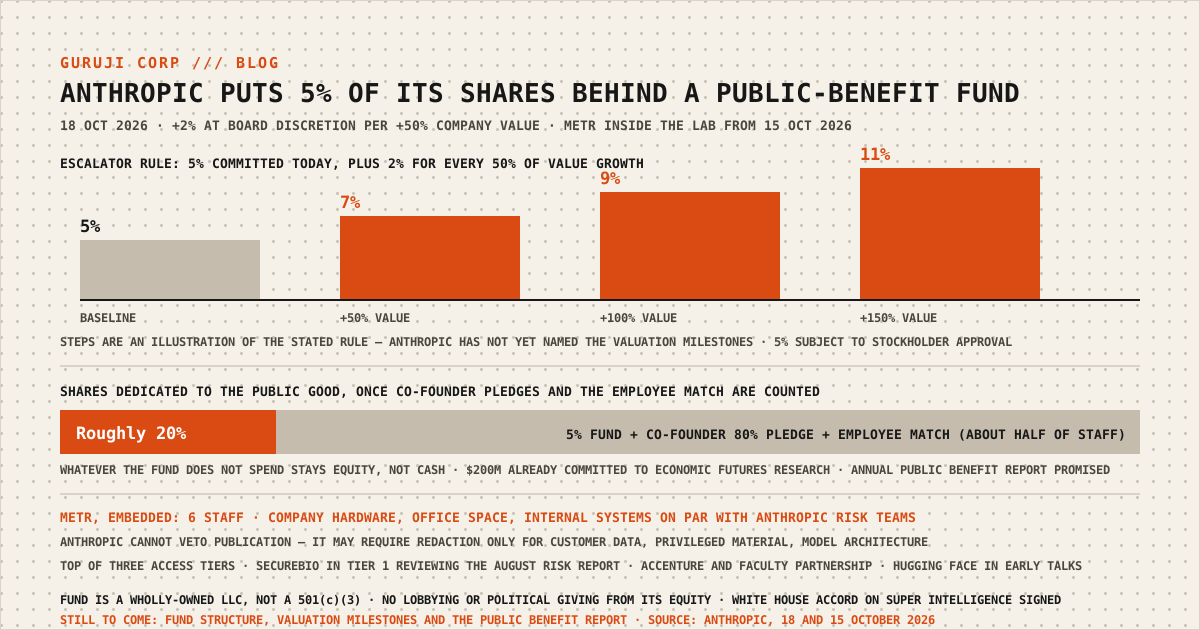
Anthropic committed 5% of its shares to a new wholly-owned Public Benefit Fund on 18 October — the board can add another 2% for every 50% rise in company value, taking the equity dedicated to the public good to roughly 20% — and gave six METR staff employee-like access to its internal systems with no veto over what they publish.
The most interesting number Anthropic published this week is not a benchmark score. It is 2%.
On 18 October the company committed a portion of its own shares to a new entity, the Anthropic Public Benefit Fund, and the structure is the story. Subject to stockholder approval, 5% of Anthropic's shares go in now. Then the board can add another 2% for every 50% increase in the company's value above a set baseline.
Anthropic's own framing is the sharpest part of the announcement: escalating equity awards are normal practice for tech executives, and "we are instead directing that equity to the public benefit."
Three days earlier, on 15 October, the same company published the other half of the same idea: METR, a nonprofit that evaluates frontier AI models, now has six of its staff working inside Anthropic with company hardware, office space and access to internal systems roughly on par with Anthropic's own risk-assessment teams.
Read together, they are one argument — accountability you can go and check, backed by equity and by access, rather than by a safety page.
What actually happened
The fund. Anthropic is a public benefit corporation, and its post says most of its public-benefit work so far has lived inside the company: safety and interpretability research, applied biomedical research, discounts for nonprofits and scientific institutions. The new entity is meant to operate with "increased flexibility and scale," including, in its words, "large donations to traditional nonprofits or direct distributions to specific populations" — labour-market disruption being the example it names. Anthropic says it has already committed $200 million to researching and addressing that.
The chosen format is deliberate: a wholly-owned LLC, not a 501(c)(3), to keep flexibility between forms of giving. Anthropic states that none of the equity held by the LLC will be used for lobbying or political giving, in the US or abroad. The valuation milestones that would trigger the extra 2% steps are not yet named; the company says it will publish the structure, governance and milestones in the coming months, along with a public benefit report.
Where the 20% comes from. The 5% does not stand alone. Anthropic's co-founders pledged 80% of their own equity at founding, and the company runs an equity donation match that roughly half its employees use. Adding the new fund, Anthropic says about 20% of its shares will now be dedicated to the public good, "plus any additional percentage that could be added if the company reaches specific valuation milestones."
The outsiders. The METR arrangement is the more unusual of the two, because it is measurable. Six METR employees were onboarded with company hardware, office space and internal tool access. Employees are told to share information with them as they would with an internal colleague, except in a small number of defined categories: customer data, attorney-client-privileged material, and model architecture details.
Anthropic cannot veto METR's publication. It can require redaction inside those narrow categories, and METR is free to say publicly that a redaction happened and whether it considered the redaction justified. METR sits in the top of three access tiers. SecureBio is in the first tier, reviewing the chemical and biological weapons chapter of Anthropic's August Risk Report; Hugging Face is among organisations in early talks. Anthropic also says it signed the White House Accord on Super Intelligence, in which companies pledged to work with independent external auditors or evaluators, and draws an explicit analogy to bank supervision, where resident examiners sit inside the largest banks because outsiders cannot see risk positions from the outside.
METR's side of the bargain is public too. On 14 October it published proposals for how frontier developers should be assessed on loss-of-control risk, alignment, control and AI R&D acceleration, plus its approach to working with AI companies. Its track record includes a Frontier Risk Report pilot run between February and March 2026, where Anthropic, Google DeepMind, Meta and OpenAI provided non-public information and model access.
Why this matters for Indian SMBs and mid-market teams
"Trust us" has a paper trail now, and you can ask for it. The useful shift here is not the percentage. It is that independent evaluation of a frontier vendor is now a describable process with named participants, published proposals and a stated publication right. That gives a mid-market buyer a set of questions that a vendor cannot answer with a marketing page: who outside your company reviews your model before release, can they publish what they find, what are they not allowed to see, and who pays them? Anthropic's answer is voluntary and partial — one lab, one nonprofit, three exclusions — but it is an answer, and it is on the record.
Ownership structure is a vendor-risk question, not a philosophy question. If you are putting patient records, payroll, GST filing or client-confidential workflows on one API for the next three years, the question "who owns this vendor and what obligations stick to it" is as material as benchmark scores. A structure that permanently directs equity to a public-benefit entity is a mild hedge against the vendor's incentives drifting away from its stated mission after a funding round or an acquisition. It does not remove the risk. It makes one part of the risk contractually visible.
Read the mechanism, not the headline, if you want to copy it. For an Indian firm or trust considering something analogous — CSR-funded capability building, an endowed skilling fund — Anthropic's choice of a wholly-owned LLC over a charitable vehicle is the interesting design decision, because it buys flexibility at the price of tax treatment and external scrutiny. What makes the structure durable is what is still missing here: named milestones, published governance, and a reporting cadence. A commitment without dates is an intention.
Three things this is not. It is not cash: 5% of shares is paper until the entity sells or holds a dividend stream. It is not certification: nobody has audited Anthropic's models and declared them safe — METR is being given access to produce its own conclusions, including unflattering ones. And it is not a substitute for your own evaluation. Their evaluator tests their tasks; nobody in that arrangement tests your invoices, your tickets or your Hindi-language support queue.
Where Guruji Corporation fits in
Vendor selection is where most mid-market AI projects quietly succeed or fail, and the checks that matter are cheap. We build them into the work: a short procurement questionnaire that asks who evaluates a model externally and whether the evaluator can publish, a fifty-task evaluation set drawn from your real documents and run against whichever model version your code actually resolves to, and run records that preserve which model answered which request. The point is to make a vendor claim falsifiable on your own data.
If your team is about to sign a multi-year AI contract and the diligence file has pricing in it but nothing about who reviews the model or where your data sits, talk to us. We will write the questions, run your own evaluation set against the shortlist, and tell you plainly which answers came back as evidence and which came back as adjectives.
Sources
- Investing in the public benefit — Anthropic, 18 October 2026
- An update on independent evaluators — Anthropic, 15 October 2026
- A research agenda for the Economic Futures Research Fund ($200 million) — Anthropic, 22 July 2026
- Newsroom — Anthropic (publication dates for the 14–18 October announcements)
- Our current approach to assessing risks of loss of control — METR, proposals published 14 October 2026
Want to see how we can build your project?
Send us your project outline or chat directly on WhatsApp.