
27 Hours, 2,783 Programs, 605 Deaths: Four Gemini 4 Argon Agents Beat Minecraft With Nobody at the Keyboard
Four general-purpose Gemini 4 Argon agents finished Minecraft's main story in 27 hours 14 minutes, writing and debugging 2,783 JavaScript programs between them — at a list-price cost of about $520.
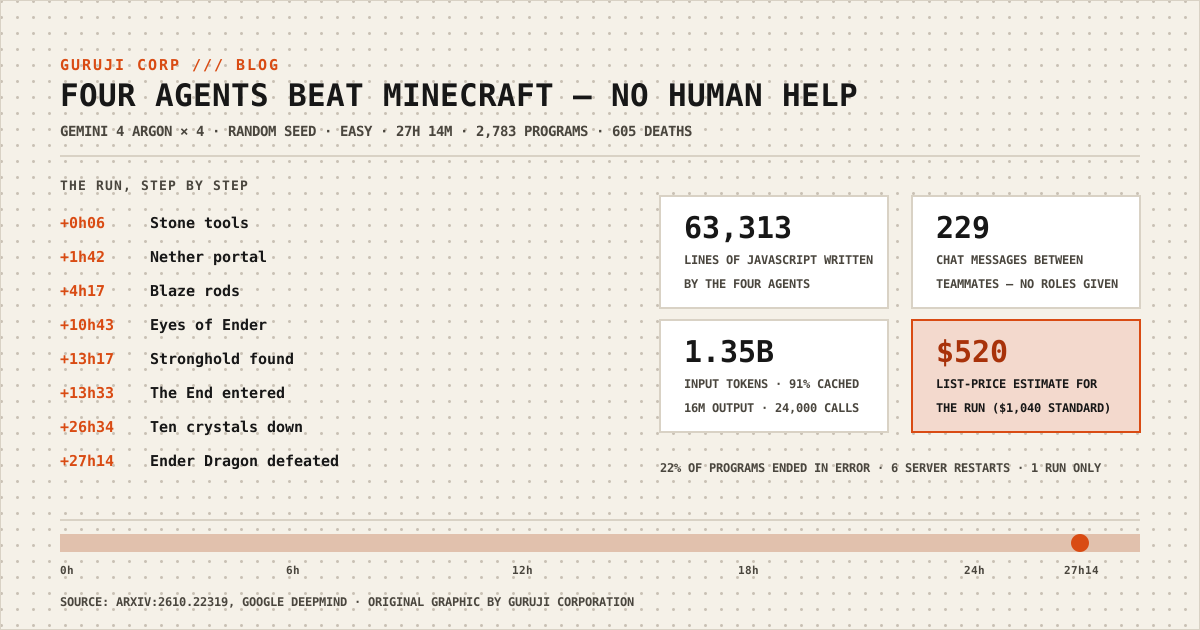
Twenty-seven hours and fourteen minutes after their first program, four Gemini 4 Argon agents killed the Ender Dragon. Along the way they wrote 2,783 JavaScript programs, exchanged 229 chat messages and died 605 times. No human assigned roles, wrote game logic or steered them out of a hole — the only instruction was a single paragraph: defeat the dragon, starting from the spawn of a shared survival world.
The paper describing the run, by Maxence Faldor, Satinder Singh and Roberta Raileanu at Google DeepMind, is short, candid about what the result does not prove, and worth reading in full (arXiv:2610.22319). It is the most concrete public evidence yet that a team of general-purpose coding agents can hold one goal together across thousands of dependent steps.
What actually happened
The setup was deliberately bare. Each agent controlled a player through Mineflayer, an open-source JavaScript library for Minecraft bots, on a standard survival server — Easy difficulty, random seed. A fifth agent, the Observer, read the session's record and published a live report but never played (paper, full text). All five ran the same general-purpose coding agent, each on its own cloud machine, with ordinary software tools and shared memory.
The agents never saw pixels and never pressed a key. Each action step was a short program: walk to these coordinates, mine every iron ore within 16 blocks, craft an item. Text came back — position, health, inventory, what was found, or the error that was hit — and the next program was written from that. The median program ran 33.5 seconds (paper).
What made a day-long run possible was memory discipline, not a better planner. The team kept 146 pieces of state and code alive between programs, including 42 reusable helper functions — one guard that makes leftover code from a timed-out program stop itself was referenced in 1,519 programs. Nineteen minutes in, an agent warned the team about a quirk in Mineflayer's crafting; the fix became a helper appearing in 655 programs. Context is compacted when it grows too long, and the instructions ask agents to carry forward what matters: work in progress and next steps (paper).
The run, in its own numbers
The published milestone timeline: stone tools at +0h06, iron tools and a bucket at +0h14, flint and steel at +1h04, Nether portal at +1h42, blaze rods at +4h17, Eyes of Ender at +10h43, stronghold at +13h17, The End at +13h33, all ten crystals down at +26h34, dragon at +27h14. In total: 63,313 distinct lines of JavaScript, 229 teammate messages, 605 deaths, six server restarts (about 20 minutes of pause) and roughly 81 in-game days (paper).
The winning idea was a correction, not a plan. One agent noticed that the crystals were healing the dragon and worked out that no pickaxe was needed to reach them — stack dirt beside each tower, punch the crystal, dig back down. Thirty-nine minutes after the last crystal fell, the dragon was dead (Faldor's write-up).
What it cost
The four players processed about 1.35 billion input tokens — 91% of them served from the context cache — and generated about 16 million output tokens, including 4 million thinking tokens, over roughly 24,000 model calls. At Gemini 4 Argon's public API list price that is about $520, or $1,040 at the standard rate; the whole session, including the Observer and a day of activity after the win, came to about $810 ($1,620). DeepMind is explicit that these are estimates from list prices and token counters, not the cost of serving the model (paper).
Read the cache number twice: long-horizon agents are affordable roughly in proportion to how much of their context they can reuse.
The fine print you should read
The limitations section is where the paper earns its credibility (paper):
- Easy difficulty, not Normal. Monsters spawned and attacked, but dealt less damage, and hunger could not kill a player.
- It was not playing from pixels. Mineflayer told the agents exactly which blocks and creatures were around them, including blocks behind solid rock and the dragon's internal state, and the pathfinding plugin planned routes around obstacles. Playing from a screen with a keyboard, as DeepMind's SIMA 2 does, remains much harder.
- The model already knew the game. Argon has read a great deal about Minecraft; the run tests whether a coding agent can turn that knowledge into working programs and coordination, not whether it can play a game it has never seen.
- It failed constantly. 22% of programs ended in an error, and the fight in the End took nearly 14 hours.
- It is one run. The first launch they tried, which cannot show how reliably the setup succeeds.
On safety the record is clean and the checks are worth copying: the in-game programs could control only their own character, could neither start processes nor write files, none used a server command, cheat commands were disabled, and none of the 2,839 programs run during the session made a network request. The Observer and a manual audit of the logs found no specification gaming (paper). Google DeepMind announced the result on 16 October (DeepMind on X), and the model underneath it went globally available a few days earlier (model card).
Why it matters for Indian SMBs and mid-market teams
1. Your durable asset is memory, not the model. The four agents won on 42 helper functions and shared notes — not on raw intelligence. The same holds for an accounts-receivable or tender-document agent: value accumulates in what you persist between runs — chart of accounts, vendor quirks, exception rules. If every run starts from zero, you pay full price for the same mistakes each month.
2. Errors are the normal state; design for them. One program in five failed, and the run still finished. A workflow that stops at the first exception will sit in a queue forever. What matters is not call success rate but cost per completed task, and whether the harness can retry cheaply.
3. A team of narrow agents beats one hero agent on long work. Nobody assigned roles; the agents divided the labour through chat, kept shared coordinates and recovered each other's dropped items after deaths. That maps onto one agent reconciling invoices, one chasing missing purchase orders, one drafting the follow-up — with a shared record of what is still open.
4. A second, non-acting agent is cheap insurance. The Observer never played. It wrote a live report, verified events and looked for cheating. For an SMB that is the affordable version of a supervisor: an agent whose only job is to read the log and say what actually happened, while a human approves anything irreversible.
5. Do not oversell this internally. It is one run, on Easy, in a game the model has read about, through an interface that hands it a perfect description of the world. The honest internal pitch is a bounded pilot with a human gate, not "overnight, unsupervised."
Where Guruji Corporation fits in
We build the harness rather than the demo: persistent task memory, retry and cost accounting, an approval step on irreversible actions, and a reading agent that reports what a run actually did. For an Indian SMB or an institutional IT cell, the useful output of a pilot is not a screenshot of an agent working — it is a measured cost per completed task, an error rate, and a clear list of steps a human must still sign off.
Contact us to scope a measured agent pilot on one real workflow — invoices, tenders, or first-line support — before you commit to a platform.
Sources - A team of Gemini 4 Argon agents beats Minecraft — arXiv:2610.22319 (Faldor, Singh, Raileanu, Google DeepMind) - Full text with run log, cost accounting and limitations — arXiv HTML - Maxence Faldor — A team of Gemini 4 Argon agents beats Minecraft (author's write-up) - Google DeepMind announcement on X, 16 October 2026 - Gemini 4 Argon — model card, Google DeepMind
Want to see how we can build your project?
Send us your project outline or chat directly on WhatsApp.