
One Model, Two Doors: Claude Fable 5.2 Costs 20% Less — and the Same Weights Are Still Behind a Verification Wall
Anthropic cut Claude Fable 5.2 to $8/$40 per million tokens on 9 November 2026, up to 30% faster than 5.1 and scoring 69.9% on FrontierSWE v2 — while the identical model without cyber safeguards ships as Mythos 5.2, only to organisations cleared through a three-tier verification programme.
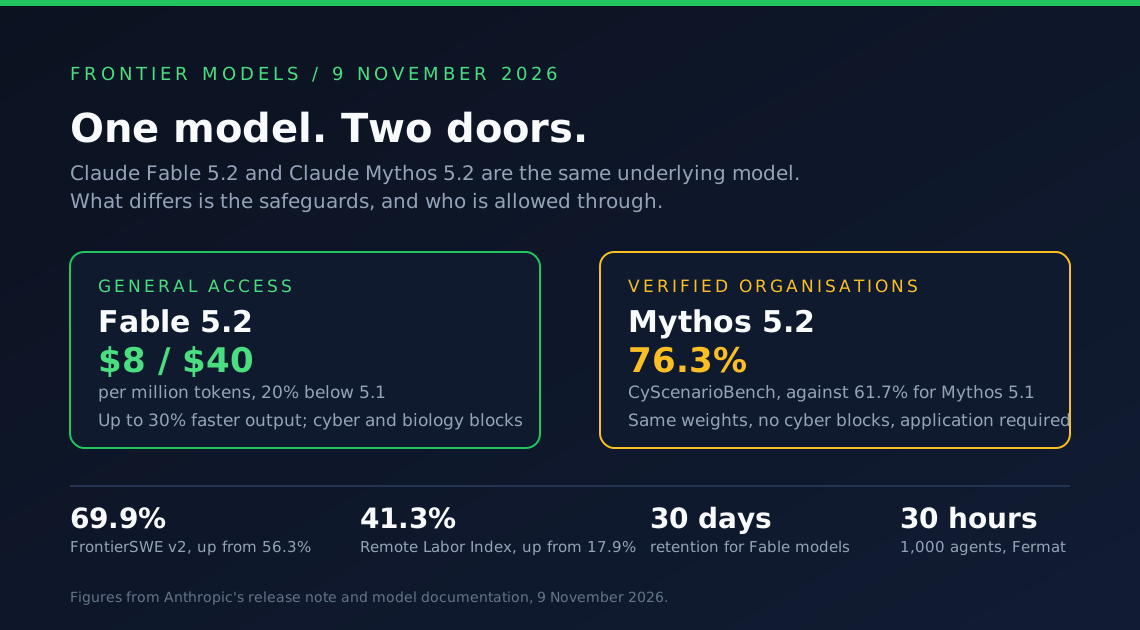
One set of weights. Two product names. One you can buy with a credit card; the other you cannot buy at all, however large the card.
On 9 November 2026 Anthropic shipped Claude Fable 5.2 and Claude Mythos 5.2, and said in the release note that they are "the same underlying model". Fable carries cybersecurity and biology safeguards, which is what lets it be sold to everyone. Mythos is the same model without those blocks, offered only to organisations verified through Anthropic's access programmes.[1]
That split — not the price cut — is what should change how a business buys AI this quarter.
What actually happened
Fable 5.2 is priced at $8 per million input tokens and $40 per million output tokens, down from $10 and $50, a 20% cut. Output is up to 30% faster. An optional fast mode raises token generation by up to 2.5×, priced at $16 and $80 per million tokens.[1][2]
The specifications are unchanged: a 1M-token context window, 128K max output, always-on adaptive thinking at a default effort of high, and a June 2026 knowledge cutoff. Cache reads cost $0.20 per million tokens and the Batch API is half price.[2]
Available from day one — Claude API, Bedrock, Google Cloud and Microsoft Foundry — with retirement promised no sooner than 9 November 2027.[2][7][9]
One internal datapoint: Anthropic says over 90% of the changes merged into its core codebase are now written by Claude, with human guidance.[1]
The benchmark that moved, and the one that did not
Anthropic publishes both its own model and three competitors on the same table.[3]
- FrontierSWE v2: 69.9%, against 56.3% for Fable 5.1, 62.3% for Opus 5.5, 65.5% for GPT-6 Astra and 61.2% for Gemini 4 Carbon.
- FrontierCode 2.0: 49.1%, against 32.4% for 5.1.
- Remote Labor Index: 41.3% at high effort, against 17.9% for 5.1 and 21.3% for Opus 5.5.
- Terminal-Bench-Science 0.1: 74.6%, or 75.3% with Mythos 5.2.
A 4.4-point lead over GPT-6 Astra on FrontierSWE is a lead, not a rout — and it is a vendor-run evaluation with safeguards on. The gap widens on long-horizon work: FrontierCode 2.0 improves by almost 17 points and the Remote Labor Index more than doubles. Those are the tasks you hand to an agent and walk away from, which is exactly the work an SMB tries to automate first.
The door: what the safeguards actually do
Fable 5.2 ships with classifiers that block high-risk cyber work — penetration testing, exploit generation, binary-based vulnerability research — and most research biology. A blocked query is answered by a smaller model instead: Opus 4.8 for cybersecurity, Opus 5 for biology.[1][3]
API customers wire that themselves: server-side fallback is in beta, and the permitted targets are Opus 4.8 and Opus 5.[4] A product that assumes one model answers every request is now architecturally wrong.
Mythos 5.2 is the same weights without those blocks, and its scores are where the security numbers live: 76.3% on CyScenarioBench against 61.7% for Mythos 5.1, and 89.6% on CVE rediscovery against 78.3%.[3][8] Mozilla, hardening Firefox across successive Mythos generations, said 5.2 "roughly doubled the vulnerability discovery metrics of Mythos 5.1" across its scanning campaigns.[1] Anthropic adds that one in six confirmed bugs found by Mythos 5.2 were missed by every other frontier model the testing company ran.[1]
Access runs through three tiers:[5]
- Defense Access — security operations, incident response, malware reverse engineering, vulnerability validation. Qualifying organisations include security teams defending systems they own, critical-infrastructure operators "of any size, such as regional hospitals or municipal utilities", smaller security firms, open-source maintainers and individual researchers. Anthropic aims to respond within days.
- Red Team Access — adds authorised penetration testing, organisations only, a few weeks of review.
- Specialized Access — the fewest blocks, for flight systems, power grids, telecom networks and interbank transfers; reviewed with the US government.
Anthropic's own tier test on Opus 5.5 is the most useful page in the programme. Without verification, all ten CyScenarioBench challenges were blocked on the first prompt; in Defense Access 46 of 50 trials were blocked at some point and four succeeded; in Red Team Access none were blocked and 34 of 50 completed — effectively the model's 67.6% unsafeguarded score.[5]
The clause that decides procurement
Fable models require 30-day data retention by default, with zero retention only by express authorisation.[2] The reason is technical — misuse spreads across sessions and accounts — and Anthropic says it is not for training on enterprise data.[6]
The fix is Enterprise Frontier Safeguards, and the architecture matters more than the name. Activity data stays in the customer's own cloud account — S3, Azure Blob Storage or Google Cloud Storage — under the customer's keys and audit logging, and automated flags go to the customer's own reviewers with no Anthropic human review. EFS costs nothing from Anthropic; you pay your cloud provider for storage. It is in private beta with customers including Bridgewater, Salesforce and Stripe, rolling out in phases.[1][6]
For an Indian mid-market firm whose client contract says "no data retention", that distinction decides whether a frontier model can be used at all.
What the upgrade costs you in code
The migration is not a string swap. The breaking changes:[4]
computer_20251124returns an error on every platform; computer use now runs through the toolset.- Thinking blocks belong to the model that produced them. Only Fable and Mythos 5.2 can read 5.2 blocks; every other model, Opus 5.5 included, has them dropped unbilled.
- Editing an earlier turn invalidates thinking blocks on every account; a prefix mismatch returns a 400 unless
thinking.block_binding.prefix_mismatch_behavioris set todrop_block. - Forced tool use is gone.
tool_choiceset toanyor to a named tool returns a 400, andtemperature,top_pandtop_kmust be omitted. - Asking for less thinking does not work. A line like "answer directly without deliberating" did not stop 5.2 thinking at
mediumeffort and above.
Anthropic's own advice is an effort sweep starting at the default, high. That is the honest cost of the 20% discount.
Why this matters for an Indian SMB
Three checks:
- Budget per finished task, not per token. List price fell 20%, but thinking is always on and effort defaults to high; a naïve swap can cost more per job. Measure before promising a client savings.
- Access tier is now an architecture decision. If part of your work is security scanning, Fable will hand those calls to Opus 4.8. Implement the fallback, or apply — the entry tier explicitly includes smaller security firms and individual researchers.
- Retention is a contract term now. Thirty days by default, zero only by authorisation or through EFS. Read the NDA before the upgrade, not after.
Where Guruji Corporation fits in
We do not resell model access, and we have not benchmarked Fable 5.2 on our own workloads — every number above is the vendor's. What we build is the layer that decides whether a swap is safe: model IDs pinned in configuration rather than floating names, a fallback path in code rather than in a deck, an evaluation script that runs our own tasks before an upgrade, and a retention line in the client contract.
If your team is about to point production at a new frontier model, send a short project brief and we will build that layer around the tools you already run.
Sources
- Anthropic — Introducing Claude Fable 5.2 and Claude Mythos 5.2 (9 November 2026)
- Claude Platform Docs — Claude Fable 5.2 overview: specifications, pricing and availability
- Anthropic — Claude Fable 5.2: benchmarks, safeguards and data retention
- Claude Platform Docs — What's new in Claude Fable 5.2: breaking changes and migration
- Anthropic — Expanding the Cyber Verification Program (three access tiers and the CyScenarioBench tier test)
- Anthropic — Developing Enterprise Frontier Safeguards with our customers
- AWS Machine Learning Blog — Introducing Claude Fable 5.2 on AWS (9 November 2026)
- Claude Platform Docs — Claude Mythos 5.2 overview
- Claude Platform release notes — 9 November 2026
Want to see how we can build your project?
Send us your project outline or chat directly on WhatsApp.