
890 Bytes Per Token: DeepSeek Cuts the Long-Context Bill to a Quarter and Retires the Model Name You Pinned
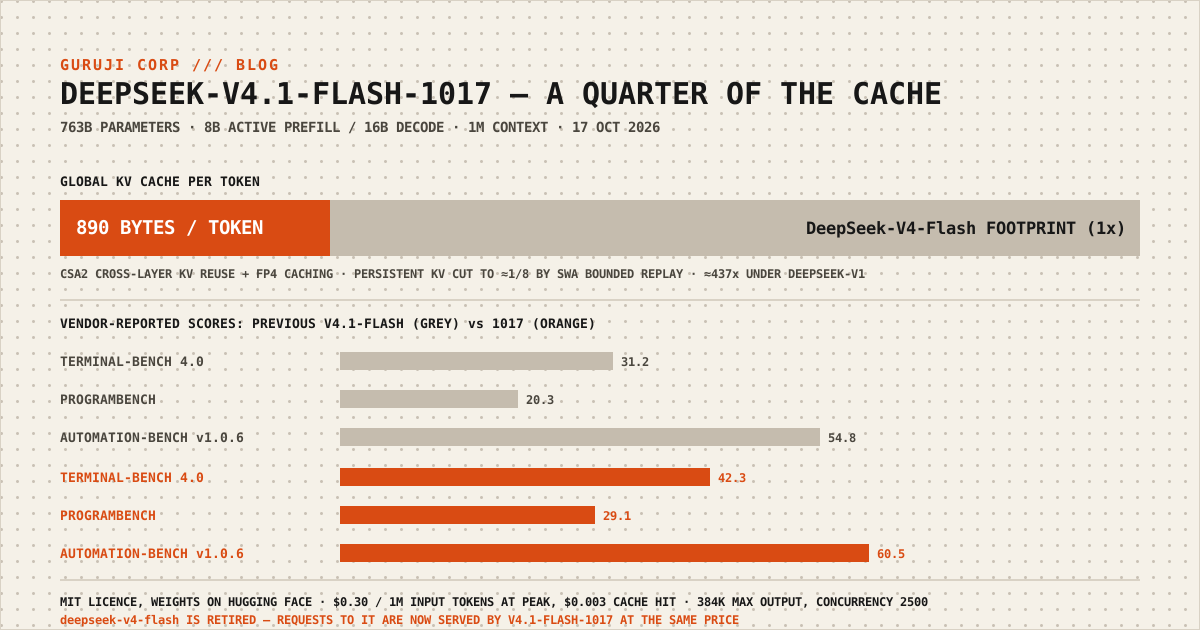
DeepSeek-V4.1-Flash-1017 landed on 17 October with Terminal-Bench 4.0 up to 42.3 from 31.2, a global KV cache of 890 bytes per token — roughly a quarter of V4-Flash — and the old deepseek-v4-flash API name now quietly serving the new model at the same price.
The most consequential line in DeepSeek's 17 October release is not a benchmark score. It is a footnote in its own API documentation: the model name deepseek-v4-flash has been retired, and requests sent to it are now answered by DeepSeek-V4.1-Flash-1017 — billed at exactly the same price.
That means every integration that pinned that name woke up on 17 October running a different model, and nothing in the response told it so.
What actually happened
The release. DeepSeek announced DeepSeek-V4.1-Flash-1017 on X on 17 October, describing "stronger benchmark performance, faster task completion, and shorter outputs than the previous version — a Pareto improvement in performance and cost," now live on the company's website, app and API. The Chinese-language release note on deepseek.com says the update "significantly improves project development capability, completing tasks at lower cost and faster speed," and adds that the API now supports web search and fetching. In the follow-up thread DeepSeek says the update uses reinforcement learning with self-feedback to improve end-to-end project development, "from game creation to 3D modeling."
The scores moved where enterprises actually pay. The model card tables each benchmark against the immediate predecessor. Terminal-Bench 4.0 goes from 31.2 to 42.3 — a third again — with DeepSWE v1.1 at 77.0 (from 74.2), ProgramBench at 29.1 (from 20.3), NL2Repo-Bench at 68.2 (from 65.4), Automation-Bench v1.0.6 at 60.5 (from 54.8), Apex Bench v1.1 at 72.1 (from 64.6) and Agents' Last Exam at 35.4 (from 31.8). The visual-agent set rises too: Chartography 83.0 (from 78.9), BabyVision 92.5 (from 89.6), ZeroBench-main 51.0 (from 49.0). On the Hard Language Exam without tools it reads 42.6 against 36.8 previously (44.0 and 39.1 on the text-only subset). All of these are vendor-reported scores on a card DeepSeek publishes itself.
The architectural story is the cost of memory, not the cost of thinking. DeepSeek-V4.1-Flash-1017 is a minor update; the design underneath it is the V4.1-Flash architecture documented in the technical report and on the V4.1-Flash model card. It is a multimodal mixture-of-experts model with a 552B-parameter backbone and a one-million-token context, built on a Causal Encoder-Decoder layout that activates only 8B parameters per token during prefill and 16B during decode — prefill is the expensive half of a long agent run, and it is the half that is being made cheap. The published checkpoint is listed at 763B parameters, alongside a 196B-parameter Engram conditional-memory table and a separately trained vision encoder.
The headline number is the cache. Combining cross-layer KV reuse in Compressed Sparse Attention 2 with FP4 KV caching brings the global KV cache footprint down to 890 bytes per token — roughly a quarter of DeepSeek-V4-Flash. A second optimisation, SWA Bounded Replay, reconstructs sliding-window attention state by replaying the most recent window instead of persisting it, cutting the footprint that must live on SSD or host memory to about an eighth. Across generations, DeepSeek's own comparison puts the reduction at roughly 4x against V4-Flash and 437x against DeepSeek-V1.
The commercial terms are unchanged, and that is the point. The API pricing page still lists deepseek-flash at $0.30 per million input tokens on a cache miss at peak, $0.15 off-peak, and $1.20 per million output tokens at peak, $0.60 off-peak — with cache hits at $0.003 to $0.006 per million. Peak hours are 01:00–04:00 and 06:00–10:00 UTC, Monday to Friday; everything else, including weekends, is off-peak. Context is 1M tokens, maximum output 384K, and the concurrency limit is 2,500. The two legacy names are accepted but retired, and the API guide notes their requests are served by the new model at the Flash price. A standalone Search and Fetch API is now billed at $0.75 per 1,000 successful requests — free when called through DeepSeek Harness, Claude Code or Codex until 1 November 2026.
And it is MIT-licensed. The weights are on Hugging Face under the MIT licence, in BF16, FP8 and INT8 tensor types.
Why this matters for Indian SMBs and mid-market teams
Your pinned model name is not a promise. The single most useful thing to take from this release is the retirement footnote. A team that wrote deepseek-v4-flash into a config in August is now running V4.1-Flash-1017 — better on almost every published number, but different, unannounced, and undetectable from the API response. If your invoice extraction prompt had been tuned around the old model's failure modes, a quality regression under the new one would look like your own data drifting rather than a vendor swapping a model. The fix is cheap: record the exact model string in every run's metadata, keep a small evaluation set of fifty real tasks, and re-run it on the day a provider ships. Version aliases are a convenience; the evaluation set is the contract.
Cache pricing is where long-context agents become affordable. The gap on DeepSeek's own page is $0.003 versus $0.30 per million input tokens — a hundredfold difference between a cache hit and a miss. Agent workloads are input-heavy by construction: the same system prompt, the same policy document, the same retrieved context, resent on every turn. A retrieval pipeline designed so that stable context sits at the front of the prompt converts directly into that cache-hit rate, and the architecture here — 890 bytes of KV state per token instead of a quarter more — is what lets a provider hold those caches at scale in the first place. If you are running document workflows over invoices, contracts or support tickets, prompt ordering and cache-hit ratio deserve a place next to accuracy in your metrics.
Open weights plus a 1M context is a real exit option. MIT-licensed weights at a published parameter count mean a firm with its own infrastructure can move a workload off the API without rewriting the pipeline around a different vendor's SDK. For teams handling health, payroll or client-confidential records, that is the difference between a data-processing conversation and a "the model runs in our network" answer.
Treat the benchmark table as a hypothesis. Every number above comes from DeepSeek's own card and its own harnesses — the card is explicit that Terminal-Bench 4.0 used the Claude Code harness and DeepSWE v1.1 the mini-SWE-V2 harness. Benchmarks measured on someone else's scaffold tell you the model improved; they do not tell you it improved on your tasks.
Where Guruji Corporation fits in
Model swaps are a maintenance problem disguised as a procurement decision. We build the layer that makes them safe: an evaluation harness that runs your real documents and your real tickets against whichever model version you point at it, prompt layouts designed around cache economics rather than aesthetics, and run metadata that records which exact model answered which request so a quality change can be traced to a date instead of argued about.
If you have AI in production on an API name you have not checked this month, the useful conversation is a short one. Talk to us and we will pull the model string your code is actually resolving to, run your own tasks against the current version, and tell you plainly whether the swap your provider made quietly on 17 October cost you anything.
Sources
- DeepSeek on X: DeepSeek-V4.1-Flash-1017 is here!
- DeepSeek on X: Build complete projects from scratch (2/4)
- deepseek-ai/DeepSeek-V4.1-Flash-1017 — model card, Hugging Face
- deepseek-ai/DeepSeek-V4.1-Flash — model card, Hugging Face
- DeepSeek-V4.1-Flash: Pushing the Limits of KV Cache Compression — arXiv:2609.19969
- DeepSeek API — Models & Pricing
- DeepSeek API Docs — Your First API Call
- DeepSeek official site — release note
Want to see how we can build your project?
Send us your project outline or chat directly on WhatsApp.