
Genie 4 Generates the World and Its Sound Together — but Forgets After Two Minutes
Google DeepMind's Genie 4 is the first real-time world model that generates ambient audio and interactive dialogue in the same pass as photorealistic video — a research preview released 27 October 2026, roughly 14 months after Genie 3, whose simulations stay coherent for only a couple of minutes.
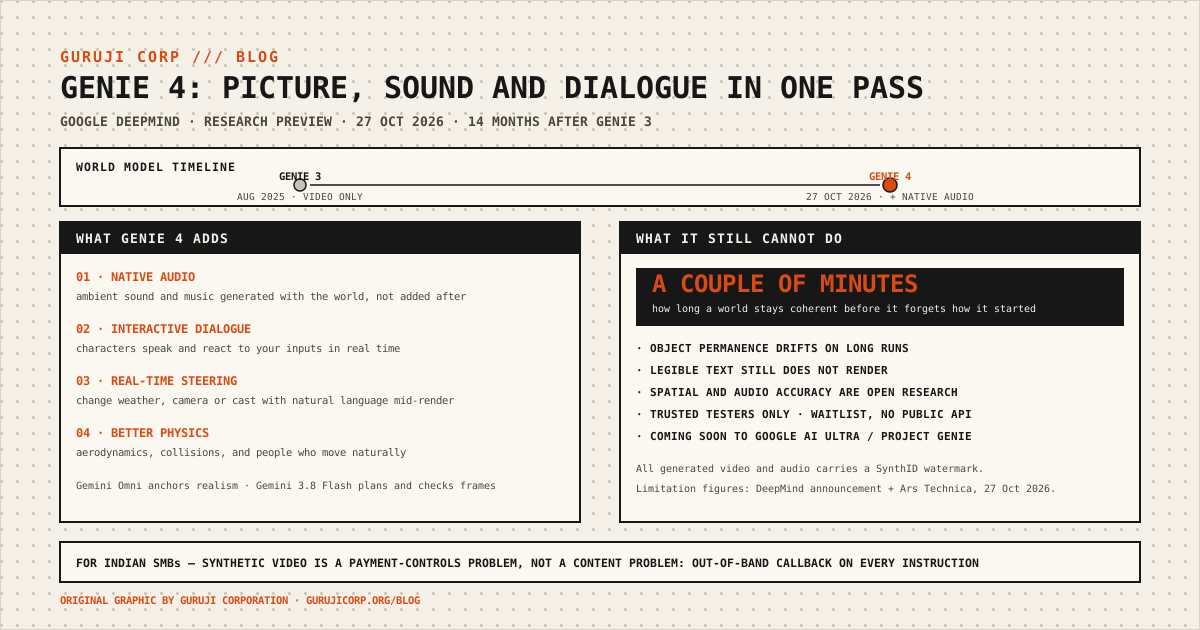
For two years the pitch for world models has been "a video game that writes itself". Genie 4, which Google DeepMind announced on 27 October 2026, moves the pitch somewhere less fun and more consequential: a simulation you can steer with a sentence, that also produces its own sound — wind, footsteps, background music, and a character who answers you back — in the same real-time pass as the picture.
It is a research preview, not a product. And the most useful thing in the announcement is not the demo reel; it is the list of what the model still cannot hold together.
What actually happened
Genie 4 is DeepMind's new world model, announced by Raia Hadsell, Diego Rivas and Hang Qi on 27 October and summarised on the Google blog the same day. It generates an interactive environment frame by frame as you move through it, rather than rendering a pre-built scene or shipping a game engine.
Three things are genuinely new against Genie 3, which DeepMind published in August 2025:
- Native audio. DeepMind calls it "our first real-time world model to generate audio natively". Every world carries the ambient sound of its own setting, and the announcement states that all accompanying sounds in its demos were produced by Genie 4 itself.
- Interactive dialogue. Characters speak, react to your inputs and respond to events in the world in real time — not a pre-recorded voice track.
- Steering in the loop. You change the weather, move the camera, or introduce a person with natural language, and the scene adapts while it renders.
The architecture is not one model doing everything. Genie 4 inherits from the Gemini family: Gemini Omni anchors the simulation in plausible real-world appearance, and Gemini 3.8 Flash runs as a guiding agent inside the loop — observing the generated frames, breaking a goal into steps, checking whether each step actually happened, and re-planning when the world drifts or the user intervenes. That planning layer is what turns a pretty video generator into something that can hold a multi-step task.
DeepMind also showed the robotics direction: Gemini 4 Argon decomposing a task into steps that Genie 4 renders, in one published example an Apptronik Apollo humanoid playing checkers. That is the doorway to the actual commercial argument — training environments for robots and agents that do not have to be built, labelled and reset by hand.
The part the demo reel skips
DeepMind's own limitations section is unusually blunt. Simulations hold together "over short sessions", and "visual details and object permanence can still shift or drift over time — especially as a simulation runs longer, after multiple complex prompt edits, or when navigating throughout the scene". Complex physical interactions, audio accuracy, rendering legible text and spatial accuracy are all listed as open research.
Ars Technica's write-up puts a number on it: Genie 4 worlds "still only remain consistent for a couple of minutes before they forget how things started". Two minutes is fine for a demo and useless for a training run that needs an hour of stable, repeatable conditions.
Access is equally limited. Genie 4 has gone to a limited group of trusted testers, with rollout "coming soon" to Google AI Ultra subscribers inside Project Genie and to early-access partners of the Gemini API and Google AI Studio. There is a waitlist, not an endpoint you can call today. Every video and audio output carries DeepMind's SynthID watermark.
Why this matters for Indian SMBs and mid-market teams
First, the fraud angle, and it is the near-term one. A model that generates photorealistic people, real-time speech and believable ambient sound in one pass raises the floor on synthetic media. The attack does not need Genie 4 specifically — but each generation makes the "video call from the boss asking for an urgent transfer" story more plausible to a finance assistant under time pressure. The defence is procedural, not technical: an out-of-band callback on any payment instruction that arrives by video, voice note or WhatsApp, and a named approver recorded against every release. If your payment run still trusts a face on a screen, fix that this quarter — the technology curve is not going to help you.
Second, the honest opportunity is prototyping, not production. Simulation as "draft mode" — a filmmaker running takes without a set, a factory layout tested before steel is ordered, a safety drill rendered for a shop floor — is the use case DeepMind's testers describe. For a mid-market manufacturer in Pune or a training company in Noida, the realistic near-term version of this is cheaper pre-visualisation: try ten layouts in an afternoon, then build the one that survived. None of it requires generative physics to be perfect; it requires the simulation to be good enough to reject bad ideas early.
Third, do not put it in an architecture diagram yet. A research preview behind a waitlist and a consumer subscription tier is not a dependency. Treat Genie-class models as a 2027 planning assumption and a 2026 experiment budget, and keep the load-bearing parts of your stack on things with an SLA, a data-processing agreement and an Indian billing entity.
Where Guruji Corporation fits in
We do not train world models and we will not claim to reproduce a lab's demo. What we do is the layer that decides whether a new capability helps or hurts an Indian organisation: verification procedures around money movement — callbacks, approval records, audit trails — built so a convincing synthetic video cannot move a payment; internal portals that log what an agent did and who signed off; and short, measured evaluations of a model against your documents and your workflows instead of a launch blog's benchmark chart.
If the question you actually have is "should we be worried about synthetic video in our payment approvals, and what would it cost to close that gap", that is a two-week piece of work, not a research project. Start with a short project brief.
Sources
- Google DeepMind — Genie 4: A new generation of world simulation (27 October 2026)
- Google — We're announcing Genie 4, our new world model for real-time interactive simulation (27 October 2026)
- Google DeepMind on X — Genie 4 announcement thread (27 October 2026)
- Ars Technica — DeepMind unveils Genie 4 world model promising more realistic physics and humans (27 October 2026)
- Google DeepMind — Genie 3: A new frontier for world models (August 2025)
- Google DeepMind — Gemini Robotics
Want to see how we can build your project?
Send us your project outline or chat directly on WhatsApp.