
GPT-6.1 Sol: Near-Astra Intelligence at $2 Per Million Tokens, One Fifth of the Flagship Price
OpenAI's GPT-6.1 Sol costs $2 per million input tokens — a fifth of GPT-6 Astra's $10 — and hits $5.47 per science task where Astra and Opus 5.5 both run past $23, making frontier-grade agent work affordable for mid-market teams.
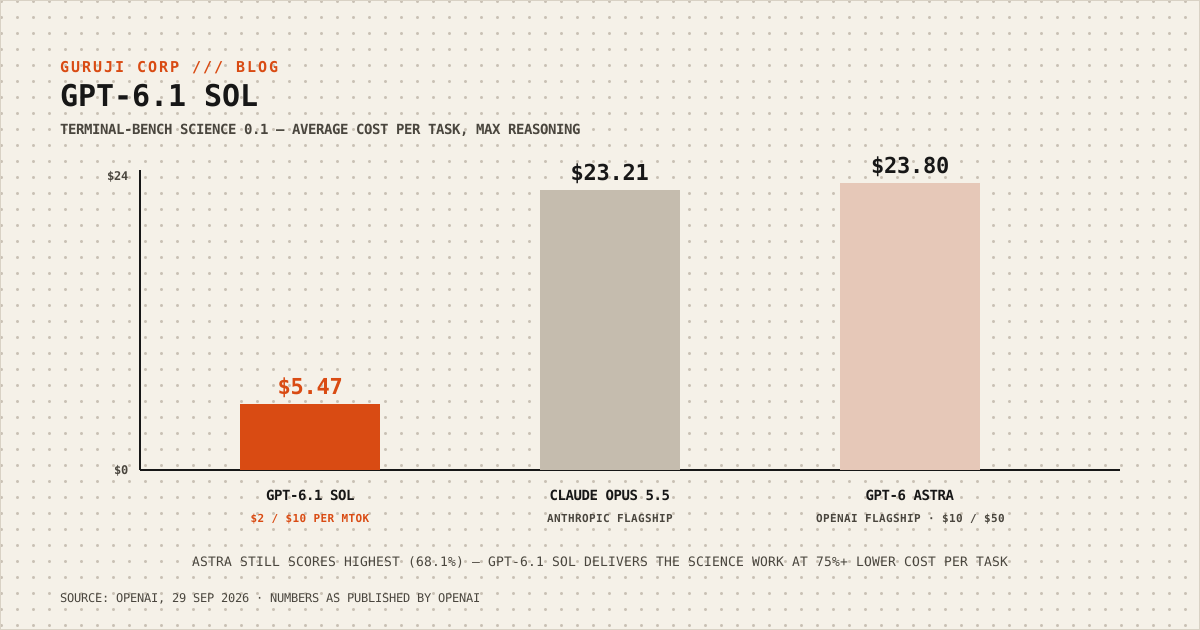
The same science task that costs $23.80 on OpenAI's flagship now costs $5.47 — and the cheaper model is not the weak one.
At DevDay 2026 on 29 September, OpenAI announced more than 20 major announcements across ChatGPT, Codex and its model line, headlined by GPT-6.1 Sol: an upgrade to GPT-6 Sol that the company says nearly matches GPT-6 Astra on agentic coding, computer use and professional work at one-fifth of Astra's standard input and output token prices.
What actually happened
The price list is the story. GPT-6.1 Sol's API pricing is $2 per million input tokens, $10 per million output tokens, and $0.10 per million cached input tokens. Cached input is 95% cheaper than the model's own standard input price and half what GPT-6 Sol charged for cached input — a deliberate push for agents that re-send the same context on every step. For comparison, the page places GPT-6 Astra at $10 input and $50 output, and the lightweight GPT-6 Luna at $0.10 input and $0.50 output.
The benchmarks OpenAI published back the "near-Astra" claim on the work that matters to businesses. On DeepSWE v1.1, which tests long-horizon software engineering inside real codebases, GPT-6.1 Sol matches GPT-6 Astra at roughly one-fifth the cost, and beats GPT-6 Sol's best score by 6.4 percentage points at a lower reasoning effort. On GDP.pdf — professional questions answered from complex PDFs with tables, charts and fine print — it scores above Anthropic's Claude Opus 5.5 (with fallbacks) at less than half the cost per task. On AutomationBench, where agents execute multi-step business workflows across 47 tools, it lands 2.2 percentage points above Opus 5.5 at medium reasoning effort for about a third of the cost, and 4.8 points above GPT-6 Sol at the same setting.
Computer use improved too. On the offline set of OSWorld 2.0, GPT-6.1 Sol beats GPT-6 Sol by seven percentage points at maximum reasoning effort at less than half the cost, and comes within 2.1 points of Astra at roughly one-seventh the cost per task.
Where it is still clearly behind. On Terminal-Bench Science 0.1, GPT-6 Astra retains the top score at 68.1% and OpenAI says it should stay the choice for the hardest scientific research. What changed is the invoice: at maximum effort GPT-6.1 Sol averages $5.47 per task against $23.21 for Opus 5.5 and $23.80 for Astra — over 75% lower per task than either. Factuality also improved: on deliberately difficult prompts at low reasoning effort the share of answers carrying a factual error fell from 11.4% to 7.7%, roughly a 32% reduction.
Availability. The model is live for Plus, Pro, Business, Enterprise and Edu users in ChatGPT Work and Codex, is not yet available in Chat, and ships to developers through the OpenAI API as gpt-6.1-sol. An Ultrafast variant with up to 8x faster token generation — 300 tokens per second in Codex — is promised "in the coming days" for GPT-6.1 Sol, with Astra Ultrafast already available on the new Pro 500 plan, which carries 25x Plus usage limits.
Everything around it. DevDay also brought always-on agents called dots — powered by GPT-6 Astra, with their own cloud computer and connections to over 4,000 apps, rolling out to Pro, Business Premium and Enterprise — plus Codex running in the cloud, a refreshed Codex CLI, and OpenAI's Private Intelligence line, which combines zero data retention with automated safety processing so OpenAI personnel do not read the underlying content. OpenAI published a system card addendum alongside the launch, reporting no observed attempts to bypass an automated safety reviewer.
Why this matters for Indian SMBs and mid-market teams
The number that matters is not a benchmark percentage — it is $2 versus $10 per million tokens for a model that holds up on coding, document work and multi-step business workflows.
- Agent workloads become budgetable. Multi-step agents burn input tokens on every tool call because the context travels with them. A 95% cut on cached input — $0.10 per million — is aimed exactly at that pattern, so an internal agent that runs a document, a CRM and a ticketing system costs meaningfully less per run than it did last week.
- The mid-tier/flagship gap narrowed to a pricing decision. Beating Opus 5.5 on GDP.pdf and AutomationBench at half to a third of the cost per task means a ten-person team can put frontier-class workflow automation into production without a flagship bill.
- Outsourced PDF and reporting work gets cheaper to automate. GST reconciliation, invoice parsing, contract abstraction and MIS generation are the GDP.pdf shape of task — dense, formatted documents with the answer buried in a table. That is where the cost-per-task story lands hardest for Indian finance and ops teams.
- Do not migrate blind. Astra still leads on hard science, the model is absent from Chat, and every vendor's own evaluations are run in the vendor's own environment with its prompts and tools. Run your real task set against your current model and GPT-6.1 Sol for a week, compare spend and quality on your documents, then decide.
Where Guruji Corporation fits in
A price halving only shows up in the books if someone rewires the calls. We build AI-assisted workflows — document pipelines, support automation, internal assistants — and a model change touches every one of them: prompts, token spend, latency, and the guardrails on what the system may do. We benchmark on your own tasks before recommending a switch, wire the migration so nothing silently degrades, and put usage dashboards in place so the claimed saving appears as a number you can check at month end.
If you are already paying for an AI model in production, the cheapest hour this week is seeing whether this release cuts the cost of the work you already do. Talk to us and we will tell you straight whether upgrading is worth it for your workload — or whether it is not.
Sources
Want to see how we can build your project?
Send us your project outline or chat directly on WhatsApp.