
The Memory Boom That Made Samsung's Phone Business Lose Money
Samsung's chip division earned KRW 106.5 trillion in operating profit in Q3 2026 while the division that builds its phones, TVs and appliances lost KRW 0.8 trillion — the clearest number yet that memory, not models, is what rations AI right now.
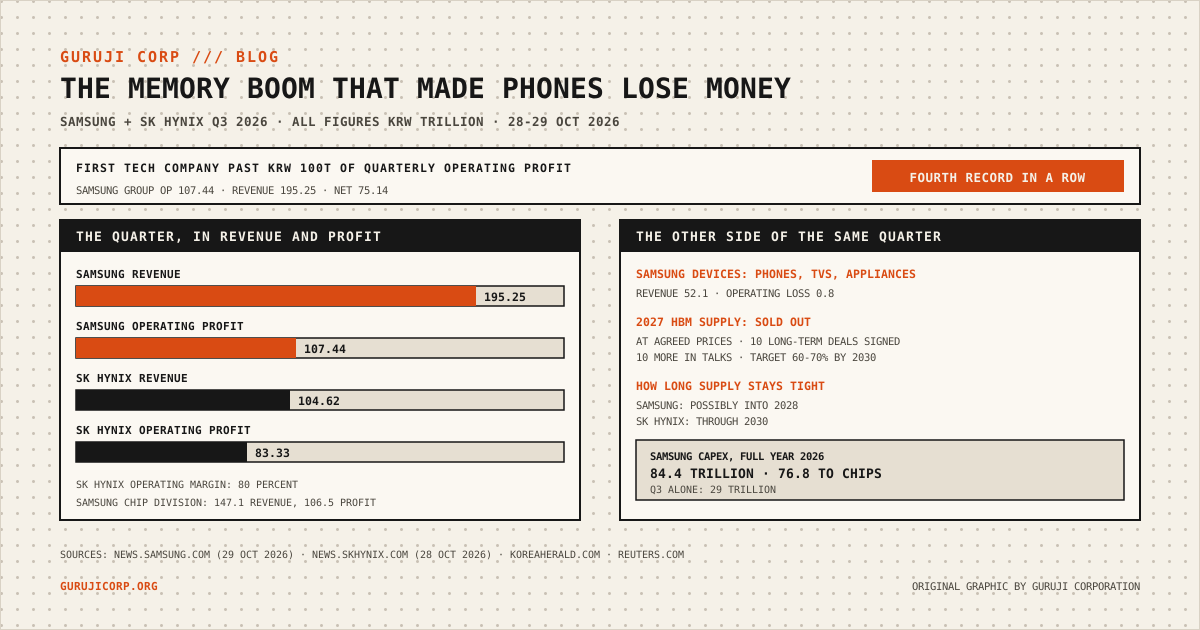
On 29 October 2026 Samsung Electronics reported KRW 107.44 trillion in quarterly operating profit — the first time any technology company has crossed KRW 100 trillion in a quarter.[4] In the same filing, the division that builds its phones, televisions and home appliances recorded an operating loss of KRW 0.8 trillion.[4]
Both numbers have one cause: memory. The component inside almost every device you buy now earns more per quarter than the devices themselves, and the two companies that make most of it have already sold their 2027 output. If you sign hardware quotations for an Indian business, that sentence belongs in your planning.
What actually happened
Samsung: a record quarter that is really a memory quarter. Consolidated revenue was KRW 195.3 trillion, up 14% quarter-on-quarter, with operating profit of KRW 107.4 trillion.[1] The Device Solutions division — semiconductors — posted KRW 147.1 trillion in revenue and KRW 106.5 trillion in operating profit.[1] The chip division made essentially the entire group profit, on about three-quarters of group revenue.
SK hynix got there the day before, and more profitably. Revenue of KRW 104.6155 trillion — its first quarter above KRW 100 trillion — operating profit of KRW 83.3338 trillion at an 80% operating margin, and net profit of KRW 39.7756 trillion, with revenue up 32% and operating profit up 38% from the previous quarter.[3]
The 2027 output is already spoken for. On its earnings call Samsung said negotiations for its 2027 high-bandwidth memory (HBM) supply were complete at agreed prices and "the volume is already sold out", with customers still asking for more.[4] It has signed long-term supply agreements with 10 major customers, is negotiating with ten more, and is targeting contracts over 60–70% of its capacity by 2030.[4] SK hynix has agreements with 14 customers covering more than half of its 2027 and 2028 production capacity, typically on five-year terms.[3] Reuters reports it describing its DRAM and HBM output as sold out through 2029, with HBM demand at roughly twice what it can supply.[5]
The new generation is the one being bought. Samsung said HBM4 sales more than tripled quarter-on-quarter and now account for about 60% of its HBM revenue.[4] SK hynix expects HBM4 to pass HBM3E in both shipment volume and revenue in the fourth quarter.[3]
How long. Samsung expects the upturn to continue through 2027 with shortages potentially extending into 2028, and says 2027 AI-driven demand will "far exceed the industry supply in comparison with 2026".[1][4] SK hynix, citing difficult leading-edge processes and years-long fab build times, expects demand to exceed supply through 2030.[3]
Where the money is going. Samsung spent KRW 29 trillion of capital expenditure in the quarter alone, and full-year 2026 spending is expected at approximately KRW 84.4 trillion, of which KRW 76.8 trillion is semiconductors.[1]
The number that should worry a buyer. The Device eXperience division — smartphones, TVs, appliances — posted KRW 52.1 trillion in revenue and an operating loss of KRW 0.8 trillion, with Samsung flagging "continued cost pressures on consumer electronics" even as it forecast stronger earnings led by chips.[4] That is not a demand problem. It is the arithmetic of buying your own input at market prices while your customers expect last year's retail price.
What is not settled. Neither company published consumer DRAM or SSD prices, HBM is a different market from the DDR5 in an office desktop, and SK hynix notes its Q3 figures are not yet finalised.[3] Anyone quoting you a specific Indian retail increase this week is extrapolating, not reporting.
Why this matters for Indian SMBs and mid-market teams
Memory is a line item in every quote you sign, and the quotes are getting shorter-lived. Laptops, desktops, servers, NAS boxes and the SSD upgrade that keeps a 2021 machine alive all carry DRAM and NAND priced off this market. A vendor who quoted a 32 GB workstation in September is not obliged to honour it in December. Put a validity window and a price-escalation clause in the purchase order, and get a delivery date in writing rather than an indicative lead time.
You are now the residual buyer. With more than half of SK hynix's 2027–2028 capacity and Samsung's 2027 HBM volume committed on multi-year contracts, an Indian SMB ordering twenty machines is buying what is left after the hyperscalers are served.[3][4] That is not a reason to panic; it is a reason to confirm orders early instead of assuming availability.
Watch the specification, not the model name. When a component gets expensive, the usual response is to hold the retail price and change what is inside — the same chassis with half the memory, or QLC NAND where TLC used to be. Compare the configuration line on this quarter's quotation with what you bought last year.
Cloud is not an escape from a memory shortage. Instance pricing is derived from the host hardware the provider bought, so the same constraint reaches you at renewal — later, and as a price change rather than a quotation.
Budget a range, and do not hoard. For three years hardware got cheaper per unit of performance; plan the next refresh as a range with a contingency and re-price before the number goes into a board note. Buying three years of laptops at once to beat a rise ties up cash and locks in a configuration you may regret.
Where Guruji Corporation fits in
We do not make chips, sell hardware or forecast memory prices — anyone who claims to know next quarter's DRAM price is guessing. What we do is the part that survives a price shock: an asset register that says what you actually own and when it genuinely needs replacing, purchase documents with validity and delivery terms that hold, and infrastructure plans costed against this quarter's numbers rather than last year's.
That work looks like our IT/OT asset portal engagements — an inventory, a lifecycle view and a procurement trail a new finance officer can audit without calling anyone. It is unglamorous, it is checkable, and it is exactly what a memory shortage tests.
If your hardware refresh falls in the next two quarters, that is a short piece of work with a written handover. Start with a short project brief.
Sources
- Samsung Electronics — Announces Third Quarter 2026 Results (29 October 2026)
- Samsung Electronics — Investor Relations, quarterly earnings materials
- SK hynix — Announces 3Q26 Financial Results (28 October 2026)
- The Korea Herald — Samsung fires back in AI chip race with record W107tr profit (29 October 2026)
- Reuters — Chipmaker SK Hynix to return $75 billion to shareholders after record quarter (28 October 2026)
Want to see how we can build your project?
Send us your project outline or chat directly on WhatsApp.