
Mistral Halved the Price and Shipped the Weights: Le Chonk Now Costs 63% Less Per Task
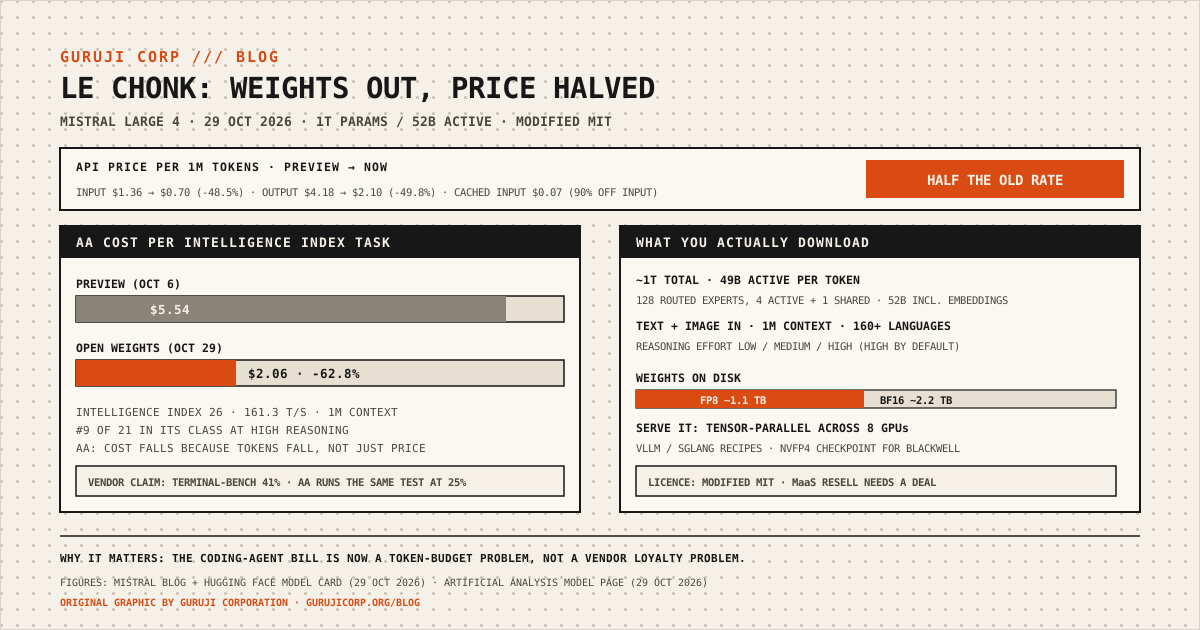
Mistral released the 1-trillion-parameter Mistral Large 4 weights under a modified MIT licence and cut API pricing to $0.70 per million input tokens, dropping the independent cost per Intelligence Index task from $5.54 to $2.06 — a 62.8% fall in three weeks.
On 6 October, Mistral said the weights of its trillion-parameter flagship would be released "by the end of this month". On 29 October they arrived — and so did a price list that halves what the model cost three weeks ago. The download is the headline everyone will quote. The pricing is the part that changes next quarter's budget.
What actually happened
The weights are real and the card is specific. Mistral Large 4 — "Le Chonk" — is on Hugging Face as Mistral-Large-4-1T-A52B: roughly 1 trillion total parameters in a granular mixture-of-experts with 128 routed experts, 4 active per token, plus one shared expert, which comes to about 49 billion active parameters per token (52 billion if you count embeddings and output layers). It takes text and images in, outputs text, carries a 1M-token context window, is natively fluent in 160+ languages, and exposes three reasoning efforts — low, medium and high, with high as the default. The card repeats the training claim from the preview: trained from scratch on 3,800 NVIDIA Grace Blackwell GPUs in Mistral's own European datacentres.
Three more weeks of reinforcement learning moved the coding numbers. In Mistral's announcement, Terminal-Bench 4.0 rose 13 percentage points to 41% against the preview's 28%, while output tokens fell 30%; on Cognition's private FrontierCode 2.0 the model scores 19.7%, which Mistral reads as the open-weight lead. On the Artificial Analysis Coding Agent Index Mistral reports 48%, level with GLM-5.3 while using 47% fewer tokens per task. All of those are the vendor's own comparisons, and the vendor says so.
The price cut is where the arithmetic gets interesting. At preview, the API cost $1.36 per million input tokens and $4.18 per million output. From 29 October it is $0.70 input, $0.07 cached input and $2.10 output — a 48.5% cut on input and 49.8% on output, with cache reads at 90% below the input rate. Cached input is not a footnote for agent work; it is most of the bill.
Independent testing agrees on cost and disagrees on rank. Artificial Analysis assessed the open-weight release on 29 October and reports an Intelligence Index v5 score of 26 at high reasoning, output speed of 161.3 tokens per second, and a cost of $2.06 per Intelligence Index task — against $5.54 for the preview, a 62.8% reduction. The same page places the model at 9th of 21 in its size class. VentureBeat's reading of that assessment is that ML4 is now the highest-scoring open-weight model developed outside China, but still about six points behind DeepSeek V4.1 Flash and GLM-5.3 on the aggregate index. It also notes the harness gap: Mistral's 41% on Terminal-Bench 4.0 becomes 25% in Artificial Analysis's own run of the same test, and Mistral's 19.7% on FrontierCode 2.0 becomes 15% in the index version. Different scaffolds, same model — which is exactly why you should never paste a vendor benchmark into a procurement note without the harness named next to it.
The licence has one carve-out. The model ships under the Mistral Ecosystem Open-Weight License, described as a modified MIT: free to use, modify, fine-tune and commercialise, with a single condition — a business operating a Model-as-a-Service offering needs a separate commercial licence from Mistral. That condition is soft at the edges. The announcement does not define where wrapping a model in your SaaS ends and selling model access begins.
"Self-hostable" is a hardware statement, not a vibe. A trillion parameters is about 2.2 terabytes of weights at BF16 and roughly 1.1 terabytes at 8-bit. Mistral's own serving recipes use --tensor-parallel-size 8 in vLLM and --tp-size 8 in SGLang, and there is a separate NVFP4 checkpoint for Blackwell GPUs. This is a GPU-node download, not a workstation download. The Hugging Face card also notes an embedded DSpark speculative-decoding head that Mistral measured at up to 1.9x throughput over serving the target model alone.
Why this matters for Indian SMBs and mid-market teams
The bill you are actually managing is cost per task, not cost per token. Take a realistic coding-agent task: 1.5 million input tokens of repository and system prompt with 85% served from cache, and 40,000 output tokens. On the new Mistral pricing that is $0.33. The same tokens on Claude Opus 5.5 at its published $4 input and $20 output come to $1.96 — about 5.9 times more, and Opus 5.5 is the stronger model, so that is not an argument for switching, it is an argument for routing. At 500 such tasks a day it is $165 against $977. Tiered routing — a cheap open-weight model for the bulk of tool-calling and summarisation, a frontier model for the twenty percent that actually needs it — is now a line item, not an architecture debate.
Cache design beats model shopping. At $0.07 per million cached tokens, the difference between an agent that re-reads your codebase every step and one that keeps a stable cache prefix is roughly a factor of ten on input spend. Most Indian teams experimenting with coding agents have never looked at their cache hit rate. It is available in the API response, and it is the first dashboard worth building.
Self-hosting is a data question before it is a cost question. Nobody is putting 1.1 terabytes of weights in an office server room in Noida, and renting eight B300s to serve a model at 26 on an index is rarely cheaper than $0.70 per million tokens. The honest reason to self-host is data: weights on your infrastructure mean the prompt never leaves it. For an Indian entity handling patient records, claim data or client contracts, that is sometimes the whole conversation — and it is a conversation about infrastructure spend, not patriotism.
Read the licence before you productise anything. If your roadmap is "we will host an open model and sell access to it", the MaaS carve-out is the clause that decides whether your business model is allowed. The safe reading is the conservative one: get a commercial licence from Mistral before you put this model behind a paid API.
Where Guruji Corporation fits in
We do not train models, and shipping someone else's weights does not make us an AI lab. What we do is the work that turns a release like this into a decision an Indian organisation can defend: measure cost per task on your workload instead of a leaderboard, design the cache prefix and routing between a cheap open model and a frontier one, check a licence before it becomes a legal problem, and document the whole thing so the next audit does not start from zero.
If the question is "our agent bill doubled and nobody can say why", that is a two-week piece of work with a written handover, not a migration project. Start with a short project brief.
Sources
- Mistral — Mistral Large 4 (Le Chonk) is now open weight (29 October 2026)
- Hugging Face — mistralai/Mistral-Large-4-1T-A52B model card
- Hugging Face — Mistral-Large-4-1T-A52B-NVFP4 quantized checkpoint
- Hugging Face — Mistral Ecosystem Open-Weight License
- Artificial Analysis — Mistral Large 4 (high): intelligence, speed, price and cost per task
- Artificial Analysis — Intelligence Index v5
- VentureBeat — Mistral Large 4 arrives as the top open model outside China (29 October 2026)
- Mistral — Mistral Large 4 public preview (6 October 2026)
- Anthropic — Claude Opus 5.5 pricing and benchmarks
Want to see how we can build your project?
Send us your project outline or chat directly on WhatsApp.