
74 Billion Parameters, Only 9 Billion Active, 24GB of RAM: NVIDIA's Open Agent Model Lands Today
NVIDIA's Nemotron 3.5 Bolt 74B fires just 9 billion of its 74 billion parameters per token and uses 2-bit quantisation-aware training to fit inside 24GB — the open-weights model is dated for 15 October, one day before RTX Spark laptops go on sale.
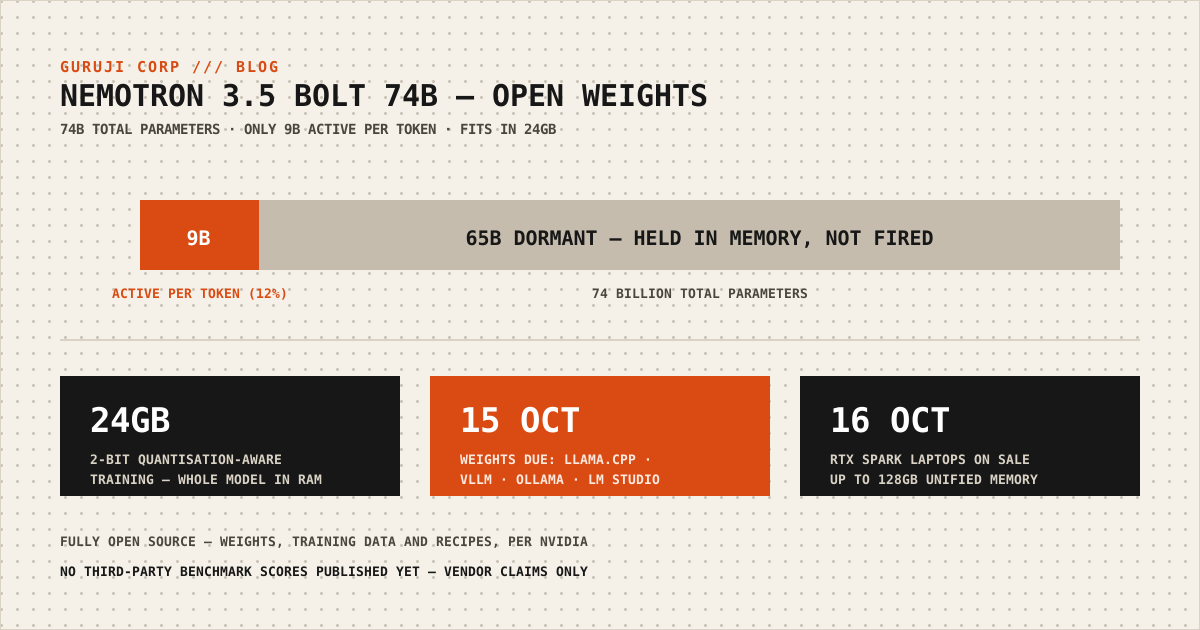
Seventy-four billion parameters of knowledge, nine billion of them switched on for any single token, and the whole model squeezed into 24GB of memory. That is the specification NVIDIA published for Nemotron 3.5 Bolt 74B, its first language model built specifically to run agents on a personal machine — dated for release on 15 October, one day before the laptops designed to run it go on sale.
What actually happened
The model. NVIDIA's announcement gives the full spec: Nemotron 3.5 Bolt 74B-A9B 24GB is a mixture-of-experts model with 74 billion total parameters and 9 billion active parameters, "packed into 24GB using 2-bit quantization with advanced quantization-aware training techniques to retain quality" (NVIDIA blog). The mixture-of-experts split is what makes the arithmetic work: the model keeps a large knowledge base but only pays the compute cost of a much smaller one on every token it writes. NVIDIA positions it as "faster than most popular dense models while smarter than most popular MoE models with a similar memory footprint" — a vendor claim published without third-party benchmark scores alongside it, so treat it as positioning until someone independent measures it.
How you run it. At launch the weights are meant to be available through llama.cpp, vLLM, Ollama, Unsloth and LM Studio, and directly accessible from agent harnesses such as Hermes and OpenClaw (same source). Unlike the frontier releases of the past fortnight — Google's Gemini 4 Argon and Meta's Muse Wonder are both closed-weight — NVIDIA states that Bolt 74B is fully open source, including training data, weights and recipes, so a team can fine-tune the model rather than rent it (same source). One practical note from our own check: as of writing, a query of Hugging Face's model API for "Nemotron 3.5 Bolt" returns nothing, so the weights appear to land later in the day on NVIDIA's own 15 October schedule.
The hardware around it. RTX Spark is a single superchip pairing up to a 20-core Grace CPU with up to a 6,144-core Blackwell GPU, up to 128GB of LPDDR5X unified memory and up to 1 petaflop of FP4 AI performance (product page). That page claims you can "run models up to 120B parameters with 1M context" on it, and states the local value proposition in NVIDIA's own words: "instant iteration, no API bills, and data that stays on your machine." Laptop preorders are open, systems ship on 16 October from Acer, ASUS, Dell, HP, Lenovo, Microsoft, MSI and Gigabyte, and compact desktops follow in November (launch event post). Announcing Surface Laptop Ultra around the platform, Microsoft's Pavan Davuluri said the unified memory means you can "run models on this laptop that simply don't fit on a traditional machine" (same source).
The agent layer is the real announcement. At the same event Microsoft made Microsoft Execution Containers generally available — operating-system-level sandboxing that lets agents run persistently in the background under OS control — while NVIDIA's OpenShell adds credential protection and monitoring on top, and OpenClaw and GitHub Copilot already support it (both NVIDIA posts). First boot offers a one-screen install of an agent app; GitHub Copilot, Hermes, OpenClaw, Perplexity, Pi and WorkBuddy will recommend a tuned local model in a few clicks. NVIDIA's open-source Switchyard router sends routine queries to the local model and pays for cloud intelligence only where it earns its keep, and GitHub Copilot's HydraFusion router is adding local models explicitly to "reduce token consumption". NVIDIA's stated market signal: local LLM downloads are already 5x higher than in all of last year (same source).
Two supporting pieces went out with it. NVIDIA PAIR, the free personal router that discovers compatible PCs on a network and distributes inference across them, officially leaves beta with llama.cpp support, direct Hugging Face downloads and RTX Spark support (PAIR page). And the developer toolchain is being finished for Windows on Arm: a first PyTorch-CUDA build, a native Python 3.15 build, a native Conda installer, and NVIDIA's claim that 97% of the top 15,000 Python wheels are ready (NVIDIA blog).
Why it matters for Indian SMBs and mid-market teams
The economics change shape, not just magnitude. Per-token pricing makes an agent's cost a function of how hard your team pushes it: a triage loop that runs all night is billed all night. A local machine converts that into a fixed, known cost. The realistic play is not "kill the cloud" — it is routing. Send classification, extraction, summarisation and test runs to a local model, and reserve frontier API calls for the steps where quality actually decides the outcome. NVIDIA is selling hardware; the useful idea for you is the routing layer, which works with or without its silicon.
Second, data locality. Prompts, files and agent context that never leave your machine remove an entire class of review: no client contract, HR record or financial extract is sitting on a third-party endpoint while an agent works on it. For teams whose compliance posture restricts where documents may be processed, "the model runs on the workstation" is a shorter conversation than a vendor questionnaire.
Third, open weights buy you an exit. A model you can fine-tune on your own corpus, with published training data and recipes, does not lock your workflow to one vendor's price list. That matters most for the narrow, repetitive tasks where a small specialised model beats a general-purpose flagship.
The counterweight: do not buy hardware before you have measured. Bolt 74B is an efficiency bet with no independent scores published yet, and NVIDIA's launch claims are its own. Validate on your real documents first.
Where Guruji Corporation fits in
We do that measurement. We take your actual volume and your actual files, run them through candidate local models and candidate cloud models, and produce a cost-per-task comparison you can defend in a budget meeting — then wire the routing so the cheap work stays local and only the hard work is billed. When a new model lands or a price changes, the comparison is re-run rather than assumed.
Contact us for a local-versus-cloud assessment on your own workloads.
Sources - All Systems Go: Global PC App Ecosystem Ready for NVIDIA RTX Spark — NVIDIA Blog - NVIDIA, Microsoft Kick Off a New Beginning for Windows PCs with RTX Spark and AI Agents — NVIDIA Blog - NVIDIA RTX Spark — product page - NVIDIA Personal AI Router (PAIR)
Want to see how we can build your project?
Send us your project outline or chat directly on WhatsApp.