
NVIDIA Buys Hugging Face for $13B — What It Means If You're Not a Tech Giant
NVIDIA's $12.93 billion acquisition of Hugging Face folds the registry the open-weights ecosystem runs on into the dominant hardware vendor. For any business building on 'open' AI, that's a vendor-risk question, not just an industry headline.
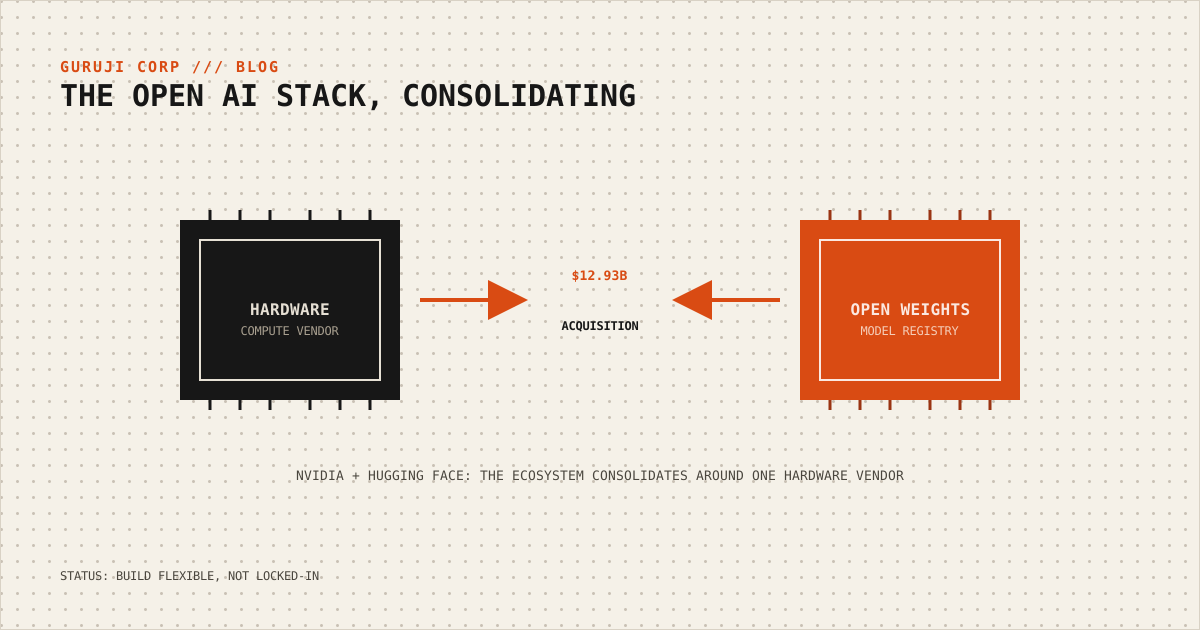
NVIDIA is acquiring Hugging Face for $12.93 billion. If that name doesn't mean much outside engineering circles, here's why it matters anyway: Hugging Face is the registry that most of the "open" AI ecosystem — open-weight models, datasets, and the tooling to run them — has been built on top of. It's now owned by the company that already dominates the hardware those models run on.
Why "open" was never quite the same as "independent"
The appeal of open-weight models for a business has always been partly about not being locked into one vendor's API, pricing, and roadmap. You could self-host, swap models, or fine-tune without asking anyone's permission. That story gets more complicated when the registry, tooling, and hosting infrastructure most of that ecosystem depends on sits inside the same company that controls the GPUs everyone runs it on.
This doesn't mean the sky is falling — Hugging Face's model format and tooling aren't disappearing overnight, and plenty of open alternatives exist. But it's a consolidation event, and consolidation events are exactly when the assumptions a business built its AI stack on quietly stop being true.
The practical question for anyone building on this stack
If your product, internal tooling, or automation depends on a specific model, a specific hosting provider, or a specific inference API, the question worth asking this month isn't "is this a problem yet" — it's "how much would it cost me to switch if it became one." Concretely:
- Can you run your core models somewhere other than where you run them today, even if it's slower or more expensive, without a rewrite?
- Is your integration code talking to a specific vendor's API shape, or to an abstraction you control that happens to call that vendor today?
- Do you actually know which specific model versions you depend on, or is that knowledge sitting in one engineer's head?
Most businesses answer "no" to at least one of these, and that's the actual risk — not the acquisition itself, but not knowing your own exposure to it.
Where Guruji Corporation fits in
When we build AI integrations for clients — a RAG pipeline, a document-processing system, an internal research assistant — we deliberately build the integration layer so the model or provider underneath it can be swapped without touching the rest of the system. That's not a defensive habit against this one acquisition specifically; it's the same discipline that makes any of our systems maintainable regardless of which vendor has a good or bad year.
If you're not sure how exposed your current AI tooling is to a single vendor's decisions, that's a half-day conversation, not a multi-month audit. Get in touch and we'll help you map it out.
Sources
Want to see how we can build your project?
Send us your project outline or chat directly on WhatsApp.