
OpenAI Lets Any Business Claim Its Spot in Front of 1.2 Billion ChatGPT Users
OpenAI launched Businesses in ChatGPT in beta on 10 November 2026: any eligible business can claim its listing, publish product feeds and prices, and read aggregated mention and click data — and eligible US ecommerce businesses can now ship a Business Agent that answers customer questions inside ChatGPT.
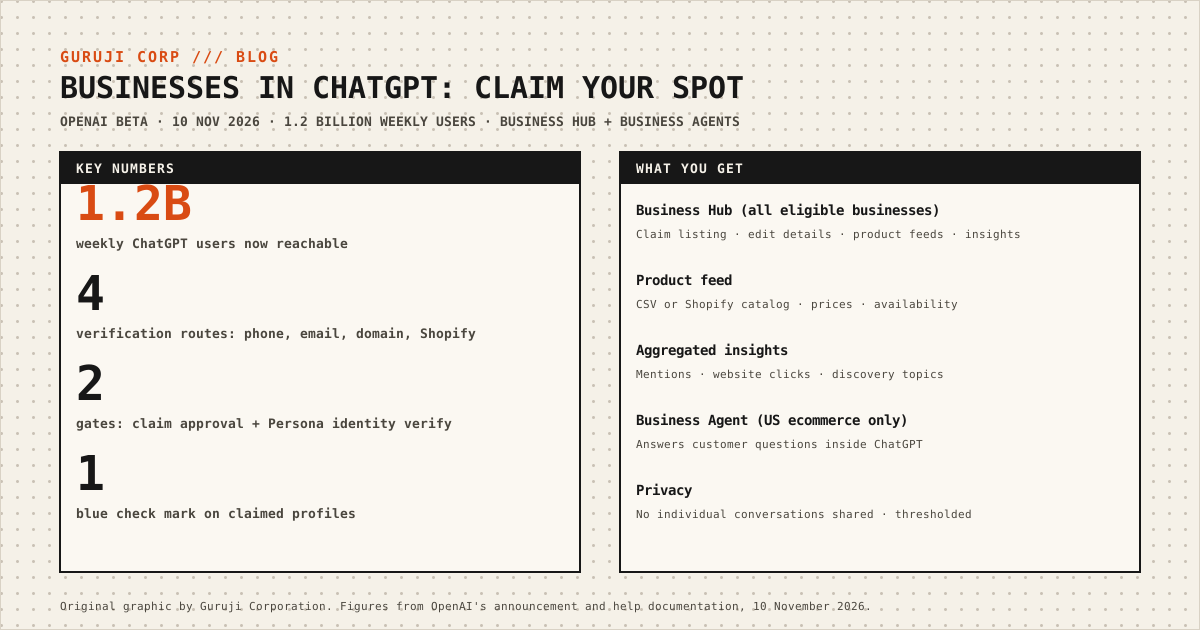
ChatGPT has 1.2 billion weekly users, and until this week most of them met your business the way they meet any other source on the internet: a link in a model response, with no way for you to correct the record. On 10 November 2026 OpenAI opened Businesses in ChatGPT in beta, and the product does one thing that matters for a small business: it gives you a page you control inside the chat.[1]
What actually happened
The product is Business Hub, reached from the sidebar in ChatGPT on the web. Through it, a business can claim its listing, verify that it owns the business, and then publish the details ChatGPT will use when people ask about it: name, address, hours, contact information, and — for retailers — a product feed with pricing and availability.[1][2]
Verification is not a formality. OpenAI offers four routes — business phone, business email, website domain (a TXT record in your DNS), and Shopify store connection — and after the claim is approved you still have to complete identity verification through Persona before you can publish changes, view insights, or build an agent.[2] The whole thing is gated twice, and the second gate is the one that blocks most rushed attempts.
A few details in the announcement are easy to miss and worth reading literally:
- OpenAI can list you without asking. The terms state that OpenAI "may create, maintain, and display a business listing on OpenAI Properties using Customer Data and other information OpenAI is otherwise entitled to use, regardless of whether you claim, manage, or cease managing it."[4] Claiming is not opting in to being listed; it is opting in to editing what is already there. A claimed profile gets a blue check mark.[3]
- Insights are aggregated and thresholded. Business Hub shows mentions count, website clicks, and discovery topics — common themes across conversations where your site is cited. But the numbers are aggregated, never individual conversations or Business Agent chats, and a blank metric can mean the activity has not reached the reporting threshold rather than zero activity.[1][2]
- Eligibility is gated. Claiming is open to "any eligible business located where ChatGPT is available," but Business Agent creation is restricted to eligible ecommerce and online service businesses in the US with a website.[1][2] Shopify merchants get a smoother path: connect the store from Business Hub or the Shopify admin, and product data flows through the Shopify catalog.[1][3]
The part that changes the funnel
The genuinely new capability is the Business Agent. After claiming and verifying, an eligible business can build, test, and publish an agent that answers customer questions using information the business provides — product details, pricing, availability, FAQs. When the business appears in a model response, the user can click through to chat with that agent directly.[1][3]
This is not a chatbot widget on your website. It is an agent that lives inside ChatGPT, reachable from a model response, answering questions about your products without the user leaving the conversation. For a retailer, the flow becomes: user asks "what's a good standing desk under ₹30,000," ChatGPT mentions your business, user clicks, your agent answers follow-up questions about delivery time and warranty, and the user never touches your website until they are ready to buy.
Whether that converts better than a link is a measurement question, not a given. But the placement — inside the answer, not beside it — is the part that is new.
Why this matters for Indian SMBs and mid-market teams
Three things, in order of urgency:
- Claim your listing now, even if you cannot use the agent yet. Business Agents are US-only at launch, but claiming is open wherever ChatGPT is available, and the listing already exists whether you manage it or not. If your business name, address, or phone number is wrong in ChatGPT today, it will stay wrong until you claim it. The verification routes are phone, email, domain, and Shopify — pick the one you can complete this week.[1][2]
- Treat the product feed as a data-quality project, not a marketing one. A feed with stale prices or missing availability makes your listing worse than no listing, because ChatGPT will quote the wrong number to a customer who then arrives expecting a discount that does not exist. If you run Shopify, the catalog integration is the low-friction path; otherwise the feed is a CSV following OpenAI's product feed specification.[2][3]
- Read the insights as directional, not precise. Mentions and clicks are aggregated and thresholded. A blank number is not zero activity. Use them to notice trends — which discovery topics recur, whether clicks are moving — not to report a conversion rate to your board.[2]
The privacy design is worth noting for anyone who sells to enterprises: OpenAI does not share user conversations or Business Agent chats with businesses, and insights are only available above certain thresholds.[1] That is a real constraint on how much you can learn about your customers from this channel, and it is the reason a Business Agent conversation will not hand you a lead list.
Where Guruji Corporation fits in
We do not resell OpenAI products and we have not run a Business Agent campaign ourselves — everything above comes from OpenAI's announcement and help documentation. What we build is the unglamorous layer that decides whether a channel like this survives contact with your operations: a product feed that is actually current, a single source of truth for business details that does not drift between your website, your Google listing and your ChatGPT listing, and a measurement plan that treats aggregated, thresholded metrics as what they are rather than as a dashboard to present to a client.
If you are about to claim a listing or connect a product feed and want the feed plumbing and the data hygiene built around the systems you already run, send a short project brief.
Sources
Want to see how we can build your project?
Send us your project outline or chat directly on WhatsApp.