
OpenAI Quadrupled Its Bug Bounty and Kept 250 People Hunting Anyway
On 2 November 2026 OpenAI more than quadrupled the midpoint of its bug-bounty ranges — up to $30,000 for a critical bug in ChatGPT, Codex or the API Platform, and up to $172,000 with bonuses — while its own security sprint had already put 250+ people across 100+ service areas on the same problem.
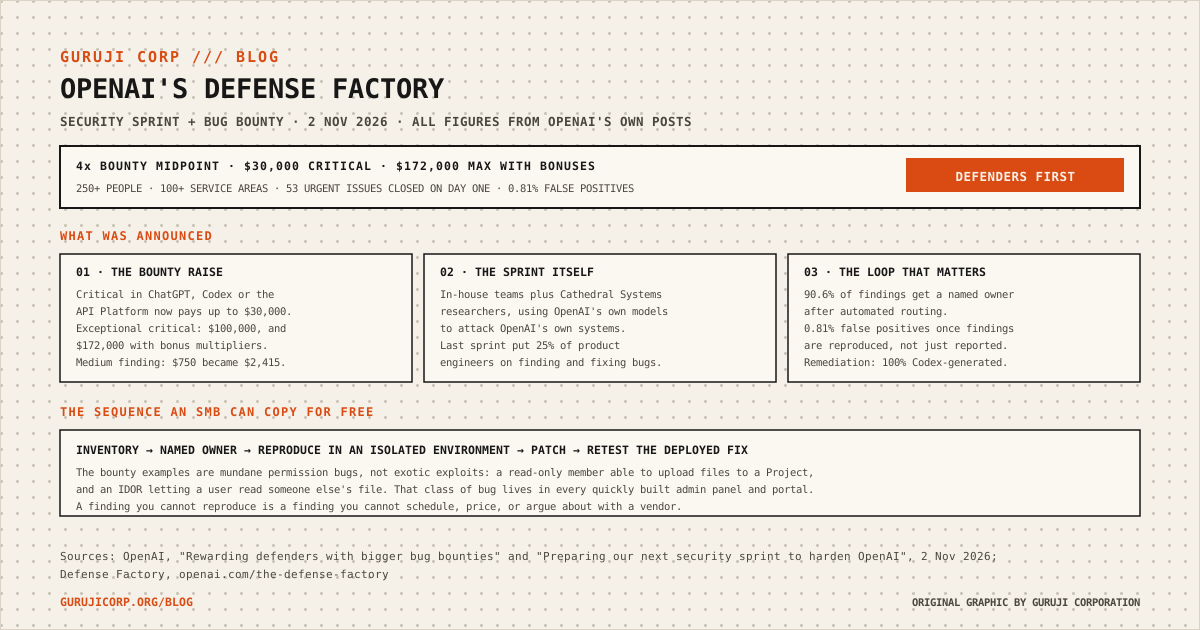
On 2 November 2026 OpenAI published two security announcements on the same afternoon. The first more than quadrupled the midpoint of its bug-bounty reward ranges for medium, high and critical findings. The second announced its next internal security sprint with an outside firm, Cathedral Systems, whose researchers will use OpenAI's own models alongside OpenAI's teams to attack OpenAI's systems.
Read together they describe one loop, and the loop is the useful part for anyone running software in India — not the dollar figures.
What actually changed in the bounty
A critical vulnerability in a core product — ChatGPT, Codex or the API Platform — now pays up to $30,000. Exceptional critical findings on those targets stay eligible for up to $100,000, and up to $172,000 once bonuses are applied. OpenAI's own worked examples put the change in concrete terms:
- A medium finding in ChatGPT (a read-only member able to upload files to a Project without write permission): $750 → $2,415, calculated as $2,000 × 1.15 quality bonus × 1.05 Bronze loyalty bonus.
- A high finding in Prism (an IDOR that let a user read a file uploaded to another user's Project): $1,000 → $3,162.50, calculated as $2,500 × 1.15 × 1.10 Gold loyalty bonus.
- A critical finding in ChatGPT (one-click account takeover): a historical $6,500, against a new base of $30,000 before multipliers.
Three bonus layers sit on top of the base award: a quality multiplier for a reliable proof of concept that isolates the bug, shows when it can be exploited and demonstrates impact; a five-tier loyalty programme for researchers who keep reporting; and priority campaigns with dedicated bonus pools for newly launched features. OpenAI's thread adds that the new ranges apply to reports already awaiting a bounty, and that awards paid in the 30 days before the change get topped up to the difference.
What the sprint had already done
The bounty post is the outside lane. The sprint post describes the inside one, and the detail is published in OpenAI's Defense Factory write-up with numbers attached:
- 250+ people mobilised across 100+ service areas in what OpenAI calls an internal code red, run with the urgency of an incident.
- 53 urgent or high-priority issues closed on the first day, before the inventory and ownership model were even finished.
- 90.6% accepted ownership after automated routing — every finding ended up with a named owner rather than a queue position.
- 0.81% false-positive rate after dynamic validation, down from whatever the raw scanners produced.
- Remediation was 100% Codex-based: agents generated patches inside reproducible development environments, reproduced each issue against a running service, and tested the fix for both the security bug and its effect on normal behaviour.
In the earlier sprint, 25% of OpenAI's product engineers were assigned to finding and fixing weaknesses, with Codex doing the investigation, the reproduction in isolated environments and the patch preparation. OpenAI has also committed $1 billion in subsidised Daybreak access over six months for defenders protecting essential services, and published a blueprint for cyber defenders aimed at governments and industry.
The three numbers worth stealing
0.81%. False-positive rate after dynamic validation is the most quietly impressive figure in the whole set. Anyone who has run a vulnerability scanner knows the opposite experience: hundreds of findings, most of them noise, and a team that stops reading them by week two. Validation — actually reproducing the issue against a running service — is what converts a finding into a fact.
90.6%. Accepted ownership after routing. A vulnerability with no owner is a vulnerability that survives. Note that OpenAI reached 90.6%, not 100%, and shipped anyway; the routing model improved while urgent issues were being closed in parallel.
100% Codex-based remediation. Not "the model found the bug". The model wrote patches, in an environment where the patch could be executed and tested. That is the honest description of where AI helps in security today: not the discovery, the reproduction and the fix.
Why it matters for Indian SMBs and mid-market teams
You will never run a $30,000 bounty, and you do not need to. The sequence OpenAI published is free: inventory the systems, route every finding to a named owner, reproduce it in an isolated environment, patch it, then retest the deployed fix. A twenty-person firm can do that with a spreadsheet, a staging server and a weekly hour. Most do none of it, which is why the same three findings reappear every audit.
The bounty examples are mundane permission bugs, not exotic exploits. A read-only user uploading files; one user reading another user's file through an IDOR. That class of bug lives in every Flask or Django admin panel, every MongoDB-backed customer portal and every "temporary" internal API. If your application was built quickly and never threat-modelled, assume the IDOR is there and test for it first — it is cheaper than a pen-test report telling you about TLS ciphers.
Pay for a proof of concept, not a severity label. OpenAI's quality multiplier explicitly rewards a report that isolates the bug, shows when it can be exploited and demonstrates its impact. Apply the same rule to whoever tests your systems: a finding you cannot reproduce is a finding you cannot schedule, price, or argue about with a vendor.
Write the remediation clock into the contract. The sprint exists because internal testing alone misses things. The bounty exists because outside researchers find what internal teams miss. For an Indian mid-market buyer, the practical version of both is a supplier clause: how fast a critical finding gets patched, who pays for the retest, and what evidence arrives when the fix ships. That clause is the same shape as the supplier obligations now appearing in Indian sectoral regulation, and it is easier to negotiate before the incident than after.
The $1 billion is not aimed at you. Daybreak's subsidised access is built for frontline defenders of essential services and digital infrastructure. A 40-person firm's route into this is the published playbook and briefing deck, not the subsidy. Read it as a free architecture document — that is what it is.
Where Guruji Corporation fits in
We do not run bug bounties, we are not a penetration-testing firm, and we will not tell you a scanner subscription makes you secure. What we build is the layer every number above depends on: an asset and system inventory that names an owner for each service, log retention long enough to reproduce a reported issue, a patch record that says what changed and who verified it, and the procurement trail that proves a fix was applied to production and not just to a branch.
That is our IT/OT asset portal work pointed at security operations, and it is the part a small team can finish in weeks. If you want to run one validation loop — inventory, owner, reproduce, patch, retest — on a single application before the year ends, start with a short project brief and we will scope it against your actual systems.
Sources
- OpenAI — Rewarding defenders with bigger bug bounties (2 November 2026)
- OpenAI — Preparing our next security sprint to harden OpenAI (2 November 2026)
- OpenAI — Defense Factory: building continuous defense
- OpenAI — Daybreak for Frontline Defenders: $1B to protect essential services (3 September 2026)
- OpenAI — Democratic governance of frontier AI, part II: Empowering cyber defenders (21 October 2026)
- OpenAI (@OpenAI) on X — bug bounty thread, 3 November 2026
Want to see how we can build your project?
Send us your project outline or chat directly on WhatsApp.