
Half Price, Nine Times Cheaper Per Task: OpenAI's GPT-6.1 Terra Puts Computer Use on a Volume Budget
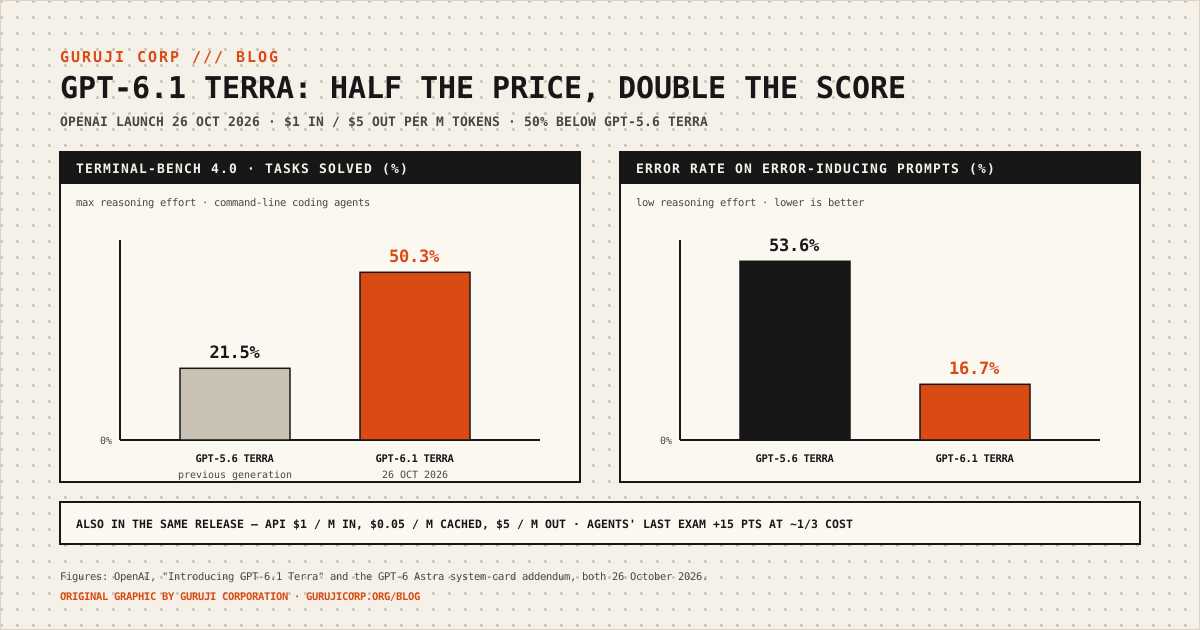
GPT-6.1 Terra lists at $1 per million input tokens and $5 per million output — 50% below GPT-5.6 Terra — while scoring 15 points higher on Agents' Last Exam and cutting the low-effort error rate from 53.6% to 16.7%.
On 26 October OpenAI shipped a model whose most interesting number is not a benchmark score. It is a price list.
GPT-6.1 Terra is positioned as a fast, efficient step up from GPT-5.6 Terra, built for the visual and computer-based work that fills an office day: drafting proposals, reading technical drawings, filling forms, editing video. The company's own framing is unusually blunt about who it is for — developers automating high-volume work such as reading incoming invoices and entering the details into accounting software.
That framing only holds because of the pricing. Standard API rates are $1 per million input tokens, $0.05 per million cached input tokens and $5 per million output tokens, which OpenAI says is 50% lower than both GPT-5.6 Terra and GPT-6.1 Sol.
What actually shipped
- Model id:
gpt-6.1-terra, available through the OpenAI API from launch day. - Subscription side: available to Plus, Pro, Enterprise and Edu users in ChatGPT Work and Codex. OpenAI states that in those products the same usage allowance now covers more tasks than with GPT-5.6 Terra, and substantially more than with GPT-6.1 Sol or GPT-6 Astra — a point that matters as much as the per-token price, because most mid-market teams buy a seat allowance, not raw tokens.
- Capability focus: visual reasoning, precise computer use, and writing that reads more naturally than its predecessor.
The number that decides automation economics
OpenAI measured computer-use performance on Agents' Last Exam, a benchmark of professional tasks that includes turning architectural drawings into a 3D model and reviewing an animated film shot by shot to build a time-coded log.
The published results: at medium reasoning effort, GPT-6.1 Terra scores 15 percentage points higher than GPT-5.6 Terra at about one-third the cost. It performs on par with GPT-6 Astra at one-tenth its price per token. At maximum effort it is over three times as token-efficient as Claude Opus 5.5 and one-fourth its price per token, which OpenAI calculates as roughly 9x lower cost per task. It also completes tasks over three times faster than GPT-6 Astra and GPT-6.1 Sol.
Read that carefully, because two different claims are bundled. The benchmark measures task success on a curated set of professional jobs. The cost figure is the price of the tokens those specific runs consumed. Your invoice-extraction workload will not match their task mix, so treat 9x as a direction, not a promise.
Factuality: the error rate fell by more than half
OpenAI's internal benchmark of deliberately error-inducing prompts is the part SMB teams should weigh hardest, because hallucination is what turns an automation project into a liability. On low reasoning effort the error rate fell from 53.6% with GPT-5.6 Terra to 16.7% with GPT-6.1 Terra — a drop of nearly 37 percentage points. At maximum effort it fell by 18 points, to 4.3%.
Even 4.3% means roughly one wrong answer in every twenty-three hard prompts. That is good enough for draft-and-review workflows and not good enough for unattended data entry into a regulated system.
Coding: 21.5% to 50.3% on Terminal-Bench 4.0
On Terminal-Bench 4.0, which tests command-line problem solving such as fixing a page whose layout shifts as it loads, GPT-6.1 Terra solves 50.3% of tasks at maximum reasoning effort — more than double GPT-5.6 Terra's published 21.5%. OpenAI is upfront that for the most complex coding work, GPT-6.1 Sol and GPT-6 Astra remain the better choice, and on Terminal-Bench-Science 0.1 Terra lands within five points of Claude Opus 5.5 at less than one-fifth the estimated cost.
Safety: a "Critical" cybersecurity rating
The system card addendum, published the same day, states that under OpenAI's Preparedness Framework the model is treated as Critical in cybersecurity and High for biological and chemical capability. It runs the same safeguards stack as GPT-6.1 Sol and GPT-6 Astra, with updated probes.
OpenAI also reports that Terra stays in scope and discloses limitations more reliably than GPT-5.6 Terra, and shows stronger resistance to prompt injection — the attack where a document or web page contains instructions meant to hijack the agent. That last improvement is the one that matters if you are handing a model a browser and a set of credentials.
Also on 26 October
Two other announcements landed the same day and are worth filing:
- Anthropic filed an S-1 registration statement for a proposed IPO, intending to list Class A common stock on Nasdaq under the symbol "ANT". The number of shares and the price range have not been determined, and the statement is not yet effective — so this is a filing, not a listing.
- CodeRabbit is using GPT-6.1 Sol as the primary model in its security agent, flagging issues across thousands of repositories and attempting exploit verification in an isolated sandbox before drafting fix pull requests for human approval.
Why this matters for Indian SMBs and mid-market teams
Cost per finished task, not per token, decides whether a workflow gets automated. With these rates, a one-page invoice at roughly 2,000 input tokens and a 300-token structured output costs about $0.0035 in model spend — our arithmetic on OpenAI's published prices, before your infrastructure and human review. At that level the constraint stops being the API bill and becomes integration, data hygiene and review capacity. That is a different, more tractable problem than the one most teams budgeted for last year.
Benchmark leadership does not transfer to your documents. A model that doubles a command-line coding score can still fail on a scanned GST invoice with a rotated stamp. Before you commit, run your own fifty-document set through it and count correct extractions, not vibes.
Volatility is now a planning risk. A 50% price cut in a single release, eleven days after the previous model's security scare, means any three-year automation business case built on today's token prices is fiction. Build the integration so the model is a swappable component: your prompt contracts, your evaluation set, your fallback.
Watch the deployment surface, not just the model. A computer-use model rated Critical in cybersecurity is a dual-use tool. If it holds a browser session, treat that session as an untrusted principal: least-privilege accounts, no stored payment credentials, and an audit log of every action it takes.
Where Guruji Corporation fits in
We do not train models and we will not claim to reproduce a lab's benchmark suite. What we build is the layer between a good model and a working office process: invoice and form capture pipelines, document extraction with human checkpoints where the error rate still demands them, and internal portals that keep a record of what an agent did and which person approved it.
If you want to know whether GPT-6.1 Terra's price cut actually changes your numbers, we will run it against your own documents and report the error rate we measured rather than the one in a launch post. Start with a short project brief.
Sources
- OpenAI — Introducing GPT-6.1 Terra (26 October 2026)
- OpenAI Deployment Safety Hub — Addendum to GPT-6 Astra System Card: GPT-6.1 Terra (26 October 2026)
- Anthropic — Anthropic files S-1 with the SEC for proposed initial public offering (26 October 2026)
- OpenAI — GPT-6.1 Sol helps CodeRabbit strengthen security across complex codebases (26 October 2026)
Want to see how we can build your project?
Send us your project outline or chat directly on WhatsApp.