
Why 80% of Companies Embed AI Agents but Only 31% Actually Use Them
80% of enterprise applications shipped in early 2026 embed at least one AI agent. Only 31% of enterprises have one running in production. The gap between the two numbers is where most AI budgets quietly disappear.
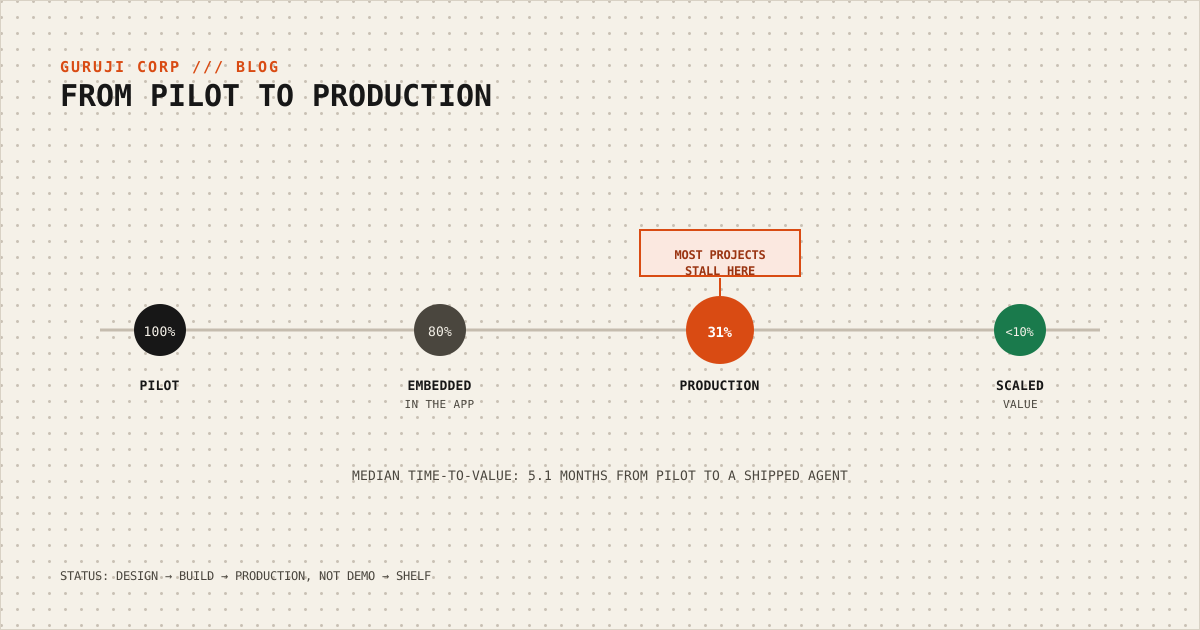
Two numbers from this year's enterprise AI data tell almost the whole story: 80% of enterprise applications shipped or updated in early 2026 embed at least one AI agent, up from just 33% in 2024. That's the easy part — everyone is trying.
The harder number: only 31% of enterprises have an agent actually running in production, and fewer than 10% have scaled one to deliver measurable value. Median time from pilot to a shipped, working agent is 5.1 months. A lot of budget gets spent in that gap before anything reaches a real user.
Where projects actually die
It's rarely the model. In our experience — and this matches what the wider data shows — agent projects stall for a small, repeatable set of reasons:
No one owns "done." A pilot has a demo date. Production has no equivalent forcing function, so the project drifts until someone loses interest or budget gets reallocated.
The demo hides the hard 20%. A clean scripted demo works because the inputs are clean. Production traffic — malformed data, edge cases, a user who phrases a request in a way nobody anticipated — is where most of the real engineering effort actually goes, and it's rarely budgeted for up front.
Integration, not intelligence, is the bottleneck. Getting a model to answer well is the easy 80%. Getting that answer to safely trigger a real action in a real CRM, ERP, or ticketing system — with retries, idempotency, and proper error handling — is the unglamorous work that pilots skip.
Nobody defined what "in production" even means. Is it live for 5% of users behind a flag? Fully replacing a human process? Different stakeholders often have different answers, and the project stalls arguing about which one it's supposed to hit.
What separates the projects that ship
Sector data backs this up directionally: banking and insurance lead production adoption at 47%, while healthcare and government trail at 18% and 14%. The difference usually isn't access to better models — it's that the leading sectors treat an agent project as a normal software delivery problem (with owners, milestones, and a production bar) rather than a research experiment that's expected to generalize into a product on its own.
Where Guruji Corporation fits in
"Problems to production" is the whole premise of how we work — it's on our homepage for a reason. When we scope an AI agent build, the production bar is defined on day one: what does "live and reliable" actually mean for this specific workflow, who owns it after launch, and what does the system do when a tool call fails halfway through. That last question alone is usually the difference between a pilot that impresses a room and a system that survives contact with real users.
If you've got an agent pilot that's been "almost ready" for a few months, that's usually a sign the production questions were never answered — not that the model isn't good enough. Get in touch and we'll help you figure out which one it is.
Sources
Want to see how we can build your project?
Send us your project outline or chat directly on WhatsApp.