
Gemini 4 Carbon Is Now Open to Everyone — at $2 per Million Tokens, Until 30 November
Google DeepMind made Gemini 4 Carbon generally available on 10 November 2026 — the model that scored 88.2% on SEC-bench Pro and 0% on the Gray Swan prompt-injection benchmark — to developers, enterprises, scientists and consumers at $2 per million input tokens and $10 per million output tokens through 30 November 2026.
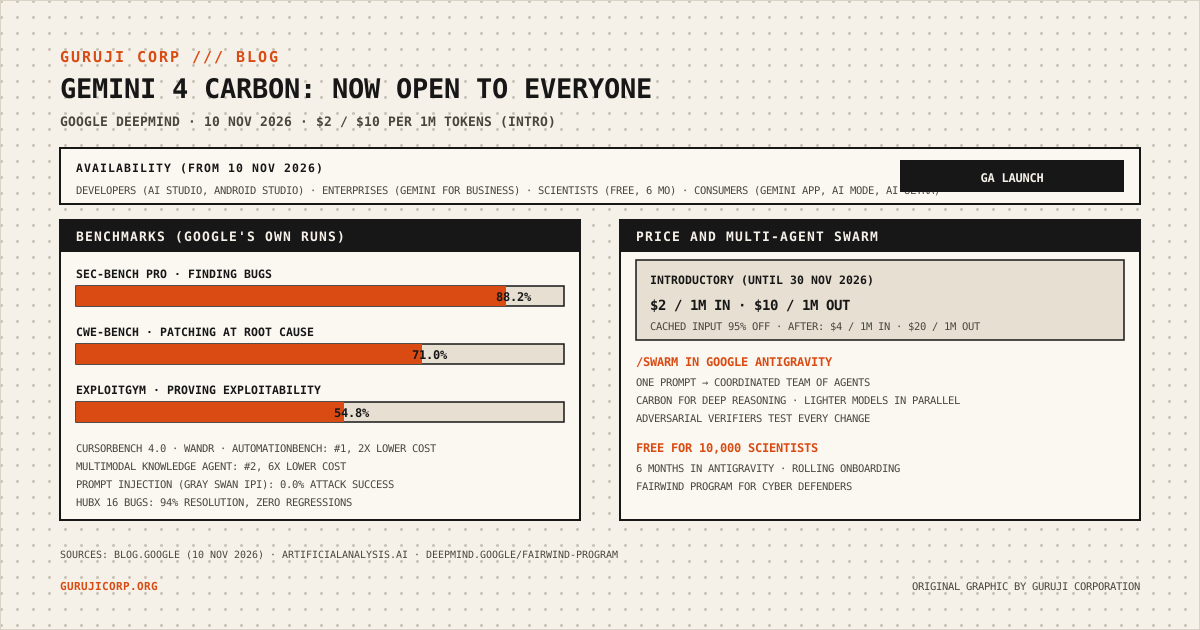
Thirteen days ago you could read about Gemini 4 Carbon but you could not buy it. Today you can. On 10 November 2026 Google DeepMind moved the model from a cyber-defender preview into general availability for developers, enterprises, scientists and consumers, at the same introductory price it announced with the preview — $2 per million input tokens and $10 per million output tokens, but only until 30 November 2026, after which it doubles to $4 and $20.[1][2]
That is the story for most IT teams: not a new benchmark, but a new price tag on a model that already topped the benchmarks, with a clock running on the discount.
What actually happened
Gemini 4 Carbon is Google DeepMind's strongest model for long-horizon, multi-step work — complex coding and debugging, cross-subsystem root-cause investigation, open-ended scientific research, and cybersecurity defence. It builds on Gemini 4 Argon, which shipped roughly two weeks earlier, and it is deliberately the heavier of the two: Argon is the right default for most software engineering and knowledge work, while Carbon is built for tasks that "test the limits of a model's intelligence", using more tokens to explore thoroughly, reason deeply and run extended verification loops.[1][3]
The availability announcement, dated 10 November 2026 and authored by Koray Kavukcuoglu, SVP at Google DeepMind, makes four concrete changes to who can use it:[1]
- Developers can build with the Gemini API paid tier in Google AI Studio and Android Studio; Google AI Ultra subscribers can also try it in AI Studio and in Google Antigravity.
- Enterprises can use it in Gemini for business via the API or model dropdown, in Google Antigravity, or through CodeMender.
- Everyday users who are Google AI Ultra subscribers can try Carbon in the Gemini app and in AI Mode in Search.
- Scientists and researchers can apply for free access to both Argon and Carbon in Google Antigravity's highest usage tier for six months, on a rolling basis, subject to eligibility, capacity and selection.
Cybersecurity defenders keep a separate door: the Fairwind Program, which is where Carbon for cyber — the variant tuned for finding, exploiting and patching vulnerabilities — is being phased in on a rolling basis.[1][3]
The numbers that matter for a budget, not a leaderboard
Google's own runs, not an independent audit, are the source for every figure below. Treat them as a vendor's best case, not a guarantee.[1][3][4]
On benchmarks that test real workflows rather than chat quality, Carbon ranks #1 on CursorBench 4.0, Perplexity's WANDR and Zapier's AutomationBench, at more than 2x lower cost per task than the next best external model. It ranks #2 on the new Multimodal Knowledge Agent benchmark, at more than 6x lower average cost per task than the top-performing model.[1]
On cybersecurity, the headline is 88.2% on SEC-bench Pro (finding real vulnerabilities in real software), 54.8% on ExploitGym (proving exploitability) and 71.0% on CWE-bench (turning findings into working patches). On internal benchmarks, Carbon achieves more than 2x the success rate of Argon at generating secure code, and the Chrome team reported Carbon performing more than 10x better than another lab's large frontier model when generating high-quality patches.[3][4]
On safety, the number that should interest anyone running an agent in production is the Gray Swan Indirect Prompt Injection benchmark: Carbon achieved a 0% attack success rate, the first time that milestone has been reached, down from Argon's already-low 0.7%. On a 375-task agentic honesty benchmark, Carbon passed 92% of tasks against Argon's 70%, and declined to fabricate missing experimental data 98% of the time.[1][3]
On cost, the introductory price of $2 per million input tokens and $10 per million output tokens (cached input at 95% off) holds until 30 November 2026. After that, $4 and $20 apply. For comparison, Claude Fable 5.2 — the other model your team is probably weighing this month — sits at $8/$40.[1][2][5]
The feature that changes how you staff a project
The availability launch also previewed /swarm in Google Antigravity: a single prompt becomes a coordinated team of agents you can track in real time. Carbon takes the roles that demand the deepest reasoning — architectural design, coordination, auditing — while faster, lighter models run in parallel across isolated workspaces, with adversarial verifiers testing every change.[1]
That is not a chatbot upgrade. It is a change in how a small team can attack a large codebase: one engineer's prompt can now dispatch a multi-agent loop that runs overnight. The blog's own examples are instructive — a multi-agent Carbon team rebuilt a 906K-triangle Three.js reconstruction of Google's Platform 37 office from seven planning PDFs across ten overnight loops, and another built an open-world 3D game from a single prompt.[1]
For an Indian SMB or mid-market IT team, the practical question is not whether Carbon is smarter than Argon. It is whether the harder task — the multi-package migration, the cross-subsystem root-cause investigation, the legacy contract rewrite — is worth the higher token spend and the longer run time. Argon remains the right default for most software engineering and knowledge work; Carbon is the model you reach for when the task has defeated your first pass.[1][3]
Where Guruji Corporation fits in
Guruji Corporation builds and operates AI-assisted software for Indian SMBs and mid-market teams — the kind of work where a model that runs for days on a hard problem, verifies its own output, and resists prompt injection is worth more than a model that answers faster. We are already evaluating Carbon against Argon on our own codebases for the agentic tasks our clients ask us to automate: multi-file migrations, test generation and legacy modernisation. If you want a second opinion on whether Carbon, Argon or a competing model fits a specific workflow — or whether the $2/$10 introductory price is worth locking in before 30 November — that is a conversation we are happy to have.
Try it or talk to us
If you want help deciding which model fits your stack, or want a pilot scoped before the introductory price expires on 30 November 2026, get in touch.
Sources
- [1] Gemini 4 Carbon is now available — Google DeepMind, 10 November 2026
- [2] Gemini 4 Carbon: New model for developer agents — Google, 10 November 2026
- [3] Gemini 4 Carbon: our next frontier model — Google DeepMind, 28 October 2026
- [4] Gemini 4 Carbon Safety and Security report — Google DeepMind
- [5] One Model, Two Doors: Claude Fable 5.2 Costs 20% Less — Guruji Corporation, 10 November 2026
Want to see how we can build your project?
Send us your project outline or chat directly on WhatsApp.